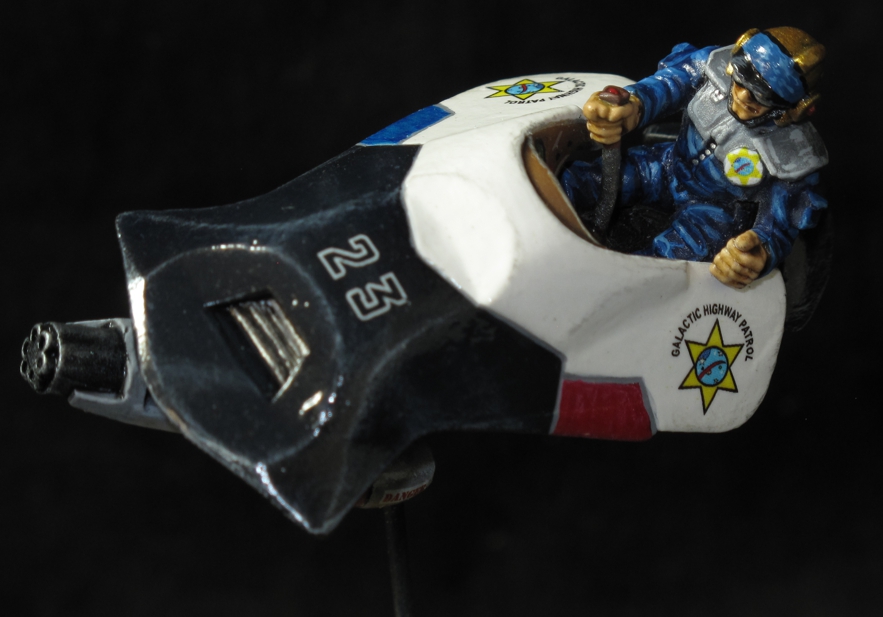
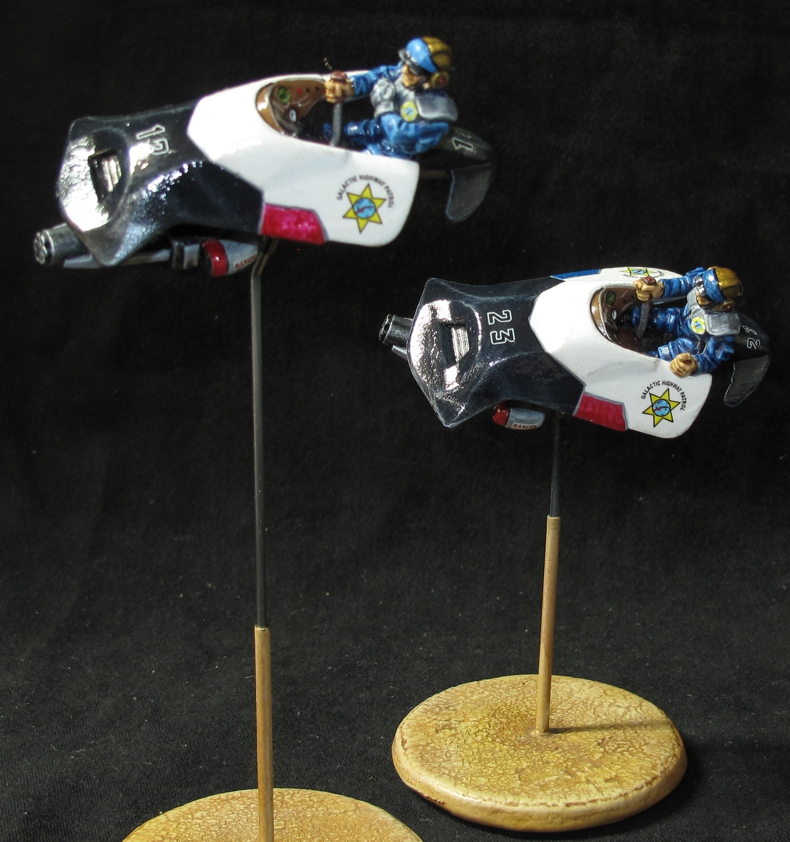
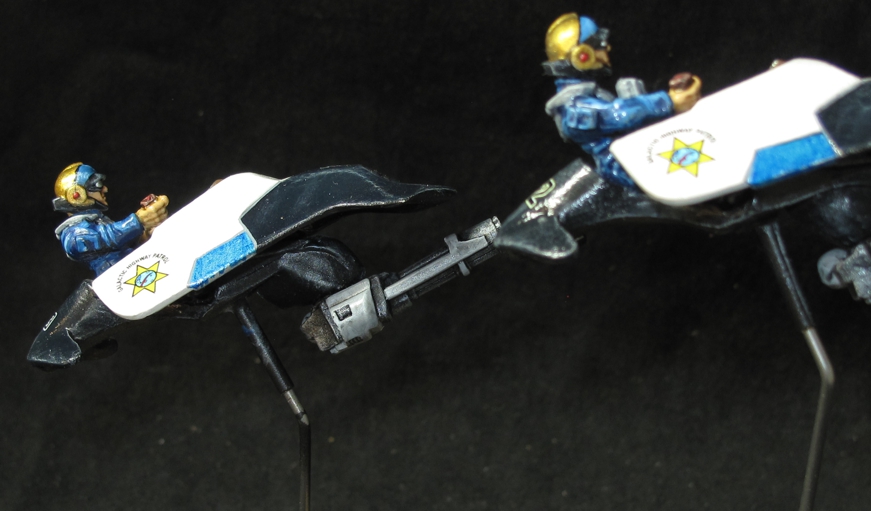
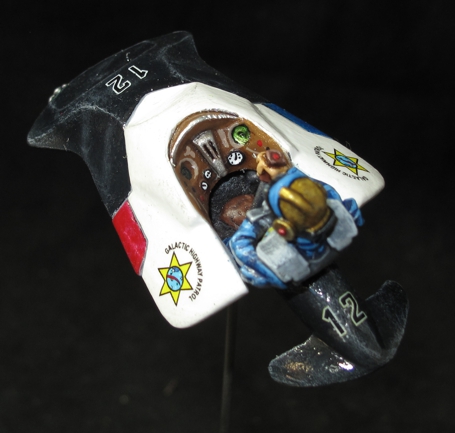
Another project off the shelf!

Like I said in my last post I’ve been hard at work…ok well I’m making a real effort to clean out my shelf of partially done projects and I got to say that things are looking good! I have 3-4 projects finished and off the shelf and ready for a bit of a photo shoot when I get the time. This project here was number 4 to come off the shelf and just happened to get in for pictures ahead of the other projects. There is still a bit of work to do on the bases, stands, and maybe a bit more weathering, but I was so happy to get the project to this point that I couldn’t wait to get it up for all to see. Funny since it has been on the shelf for at least 5 years!

I have always loved the Starship Troopers mini’s and built an entire setup that I ran at conventions several times. I wanted to add to the ST universe on the Human side with additional forces to fight the bugs. The current force I used in the games for the humans were some Games Workshop Candian troops purchased off eBay fully painted. I bought them just to get the game going for the conventions. I had painted all the bugs but did not want to wait until I had painted all the Troopers to start playing. Now these “Mercenary” troopers were very well painted but me being me I wanted something different and painted by me. I thought about getting duplicate unpainted Candians, or stripping the paint off the current ones but wasn’t thrilled by either option. I then hit upon building a whole new force, different figures, not really military (tired of painting camo uniforms) but sort of “para military” and the idea for the “GALACTIC HIGHWAY PATROL” was born! A force that patrolled the Galaxy keeping the peace, restoring order, a force that would often find itself in unexpected and dangerous situations.

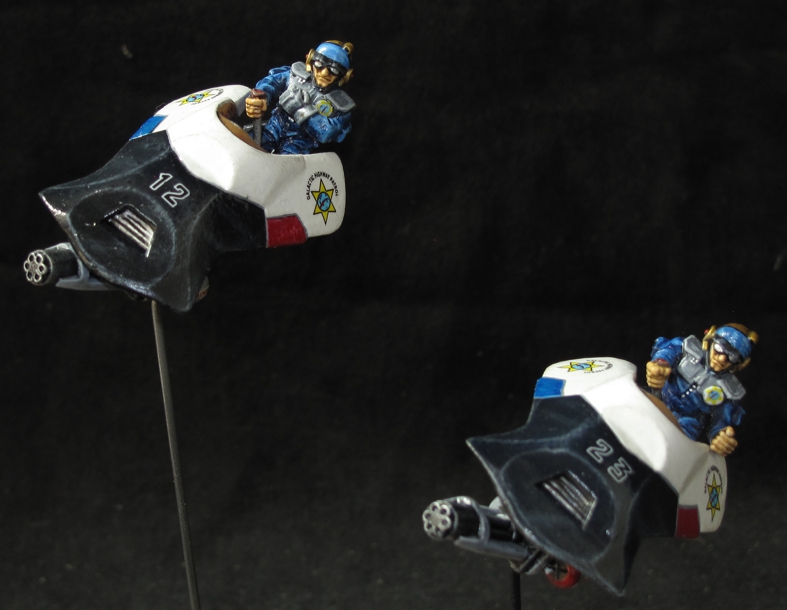
Your cruising along in your speeder on Rigeil 7, radio playing, your favorite green Orion slave girl at your side when you see this in the rear-view mirror!

I’ve collected a ton of minis for this force and this pair was the start of the project. I planned to paint them in an slightly updated style of the California Highway Patrol. A style I thought I could have fun with and would be very distinctive on the battlefield.

The decals were printed on a HP Laser printer using decal paper. The design being done with “vector” graphics instead of say a drawing program as bit map allows me to take and scale these up and down for any uniform or vehicle in the future without losing definition or sharpness! I scaled some down to make their uniform badges.

The minis were done so long ago that I can’t remember what I used other than I think the speeders were from some GW Eldar, the troopers are Candians out of a different GW flying gunship, and the Gatling cannon I picked up somewhere else. I remember I got to the point of painting them and was stuck on division of color for the vehicle and basic uniform color. I also was stuck on what to call them and how to paint all the insignia. I like to hand paint flags and such but in this scale on a more modern type project I knew that hand painting no matter how well it was done would not cut it! Finally, I bit the bullet and made my own “vector graphics” design and turned them into decals that could scaled to fit in several places.

All in all, I think it was worth the five years of contemplation!


I love the colors and the look of the California Highway Patrol now expanded into the future! The helmets came out just great!

I built a brass and steel pin system into the jet bikes frame so the under slung Gatling cannons can be swiveled around.

I’m thinking about ways to create some short clear windshields for them…..

Swedish Army (Figures for a Friend) part 2

Just a quick post to increase my sad flow of content here…lol! I do a lot more painting, building, and even playing than I post because posting is just not near as much fun or rewarding as “doing”! The last month though I have been making a real effort to catch up on projects that have been sitting on the shelf in various states of completion for one reason or another. I started by cleaning up the workbench and trying to make my painting process quicker without sacrificing the quality of work, since for me the building and painting are the most fun, playing is just an excuse to build and paint. Churning out mediocre troops in large numbers is not my thing. To do this I built a pretty cool painting accessory and changed my method of handling with the figures while painting slightly, more on that in a future article.

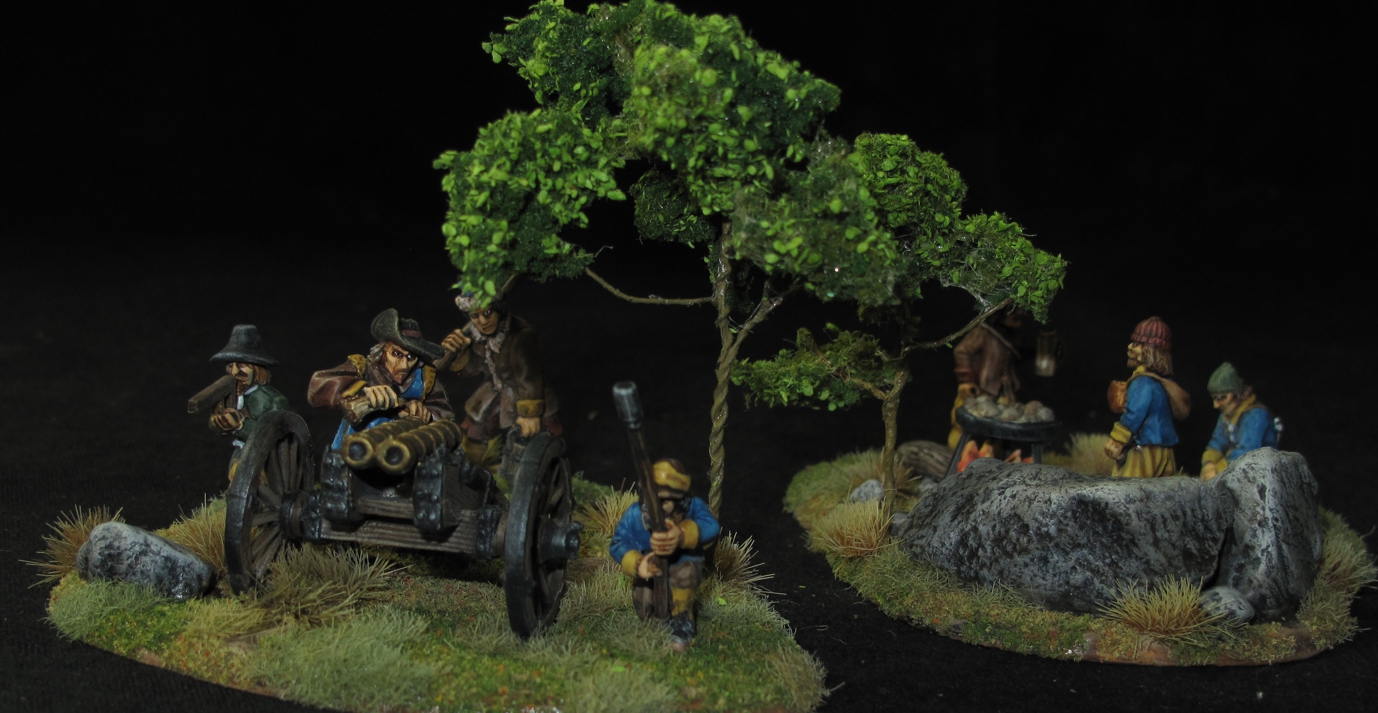
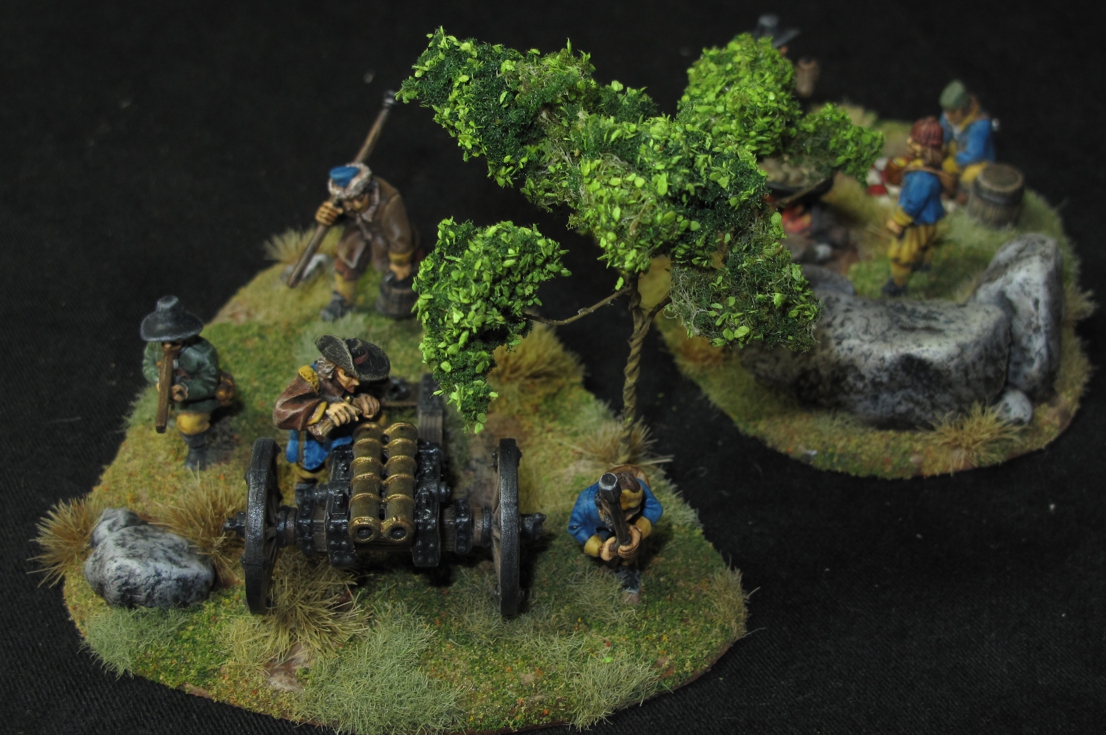
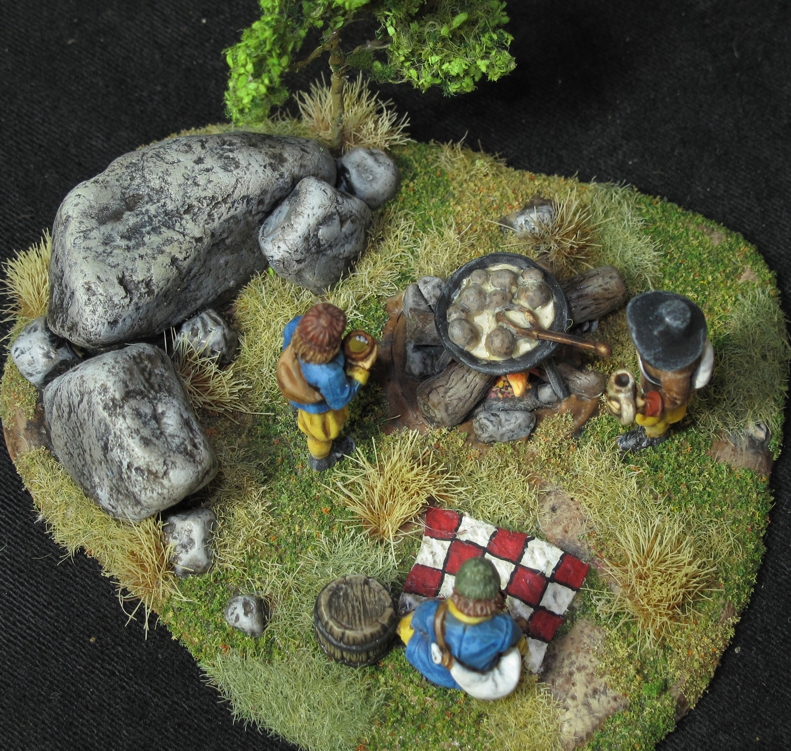
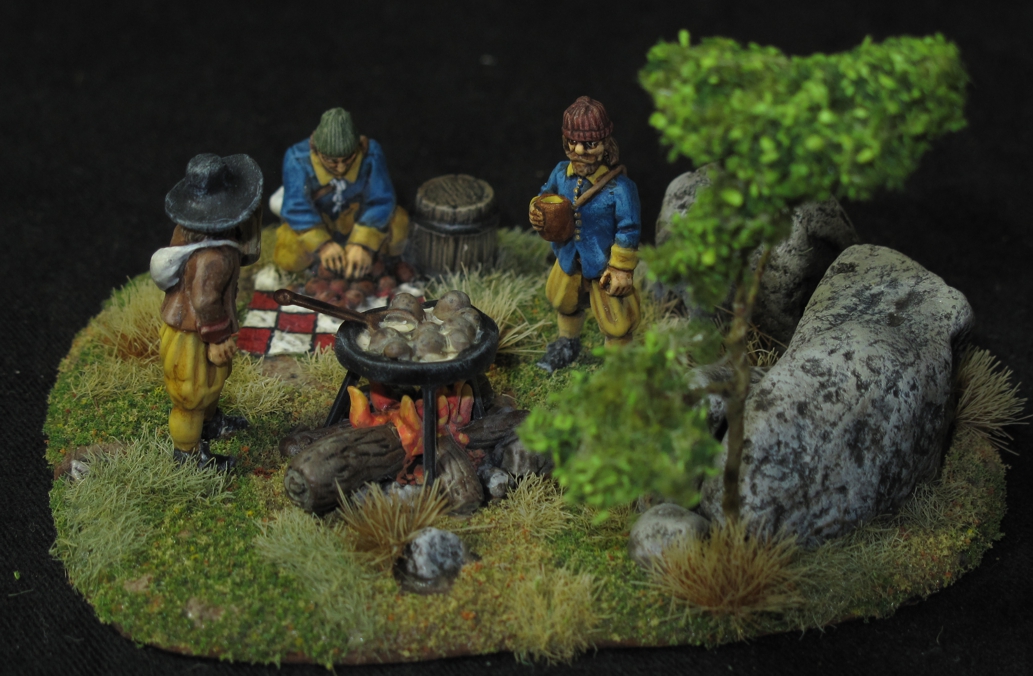
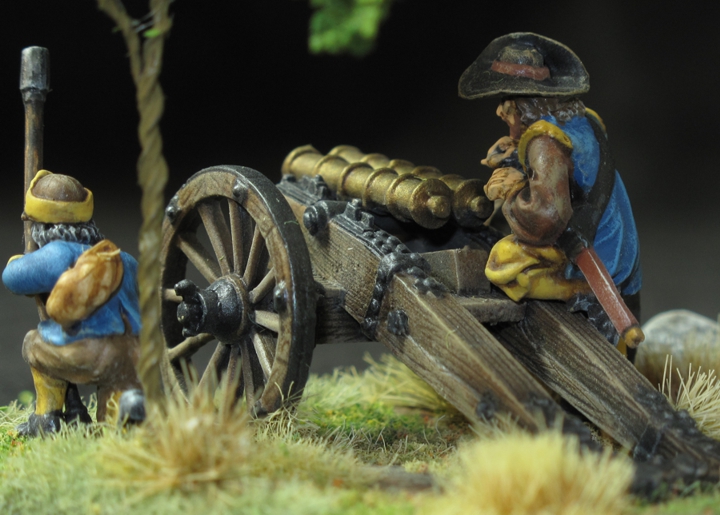
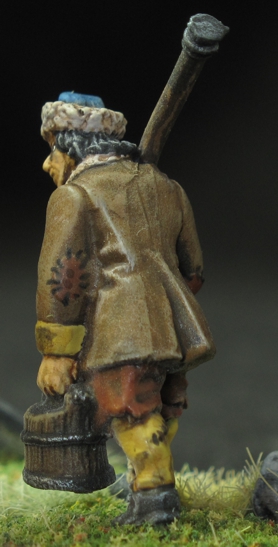
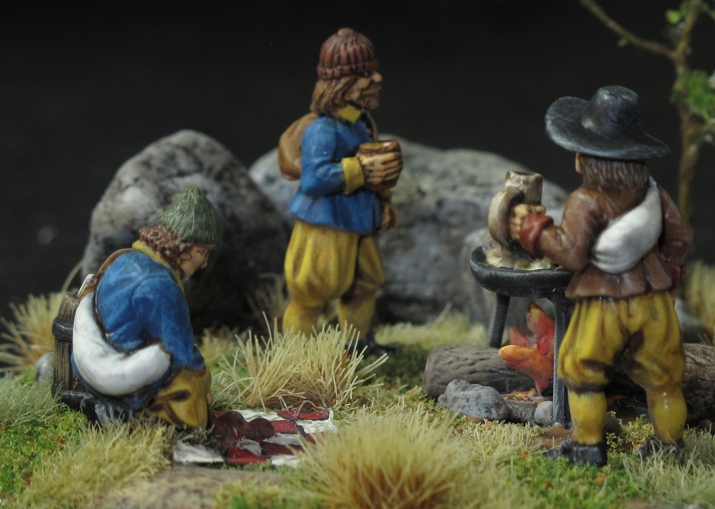
One of the first things to move to the finished pile was the last stage of the Swedish Army circa 1600 I had done as a commission for a friend. I had finished and delivered the main army last spring but the last part was the artillery section. Now my friend had pointed out that he had extra crew members for the piece and that one of them (the guy fusing the cannon balls) looked like he was making Swedish meatballs and could I possibly do a little vignette based on that. Well that itched my scratch building bones no end!

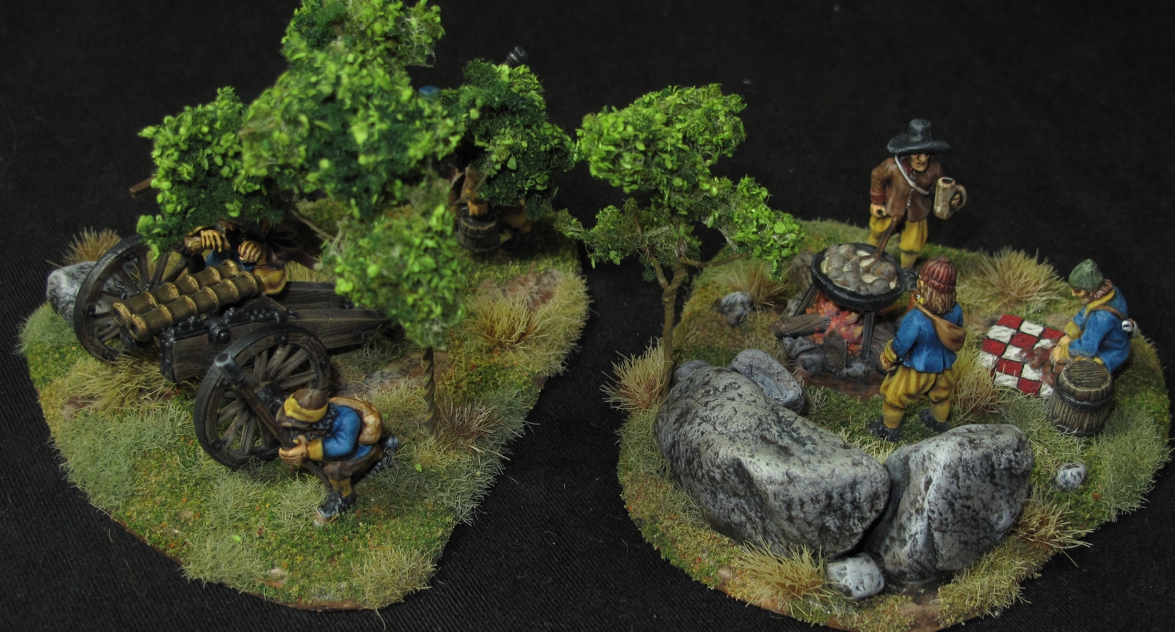
There was a lot of scratch building, the fire, frying pan, meat balls, spoon, mugs in the figures hands, “picnic cloth”, Rocks, bases, and trees. I’m not going to explain what I did as those of you who build will know and those of you who don’t wont care, I’ll simply present them and answer questions from your comments.

I did them as two bases, a sort of serious one and a fun one.

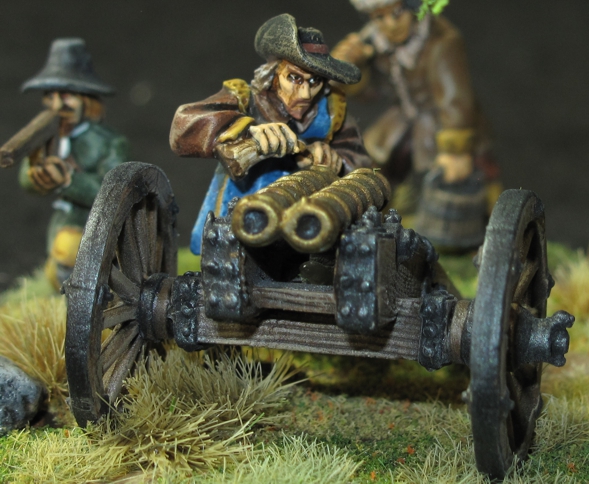
While one group mans the guns the other prepares the “Swedish Meatballs”

The “Assault Group” figures are very nice and a pleasure to paint.

Logs, fire, pan, spoon, and meatballs all made of two part kneadite epoxy.

This little vignette was just a hoot to work out and build!

The figure priming the guns is just a great sculpt and fits very well kneeling on the gun. Really makes the whole scene work!

It was a magnificent sight! Napoleonic Cavalry goes head to head!

Most commanders have a battle plan, a plan that they hope will unfold and work according to plan. This seldom happens in the Napoleonic period since once a battle commenced there was little a commander could do except to decide where and when additional forces were committed.

Commanders in the Napoleonic period spent much of their time preparing for the battle by arranging their forces to their best advantage based on what they thought the enemy commander was planning. Trying to figure out what the enemy commander was going to do was a daunting task requiring many hours of careful thought. Unlike modern battlefield leaders, commanders in the Napoleonic period had very limited resources available to them. No Aerial photography, no spy satellites, very slow communications, no radios, TV’s, computers, etc…. maps were many times lacking in detail, wrong, or just not available. General staffs were just being thought of! They had spy networks which were sometimes good, sometimes bad, and always slow! They could try and predict an enemy’s move based on what might be his immediate and long term campaign goals, go over past performance of the enemy commander, and try to get inside his head. Finally as the battle approached a commander used his Cavalry for determining enemy strength, moves, and to try and screen his own moves, strengths, and intentions.
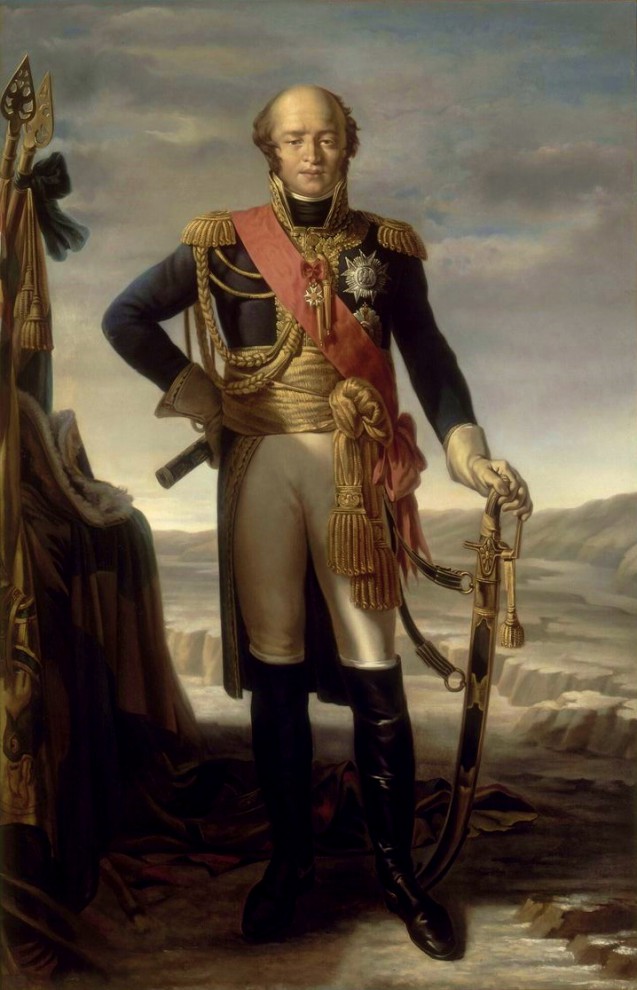
Louis Davout was one of Napoleons ablest commanders. I has been often said that if he had been present at Waterloo the outcome would have been very different.

Our Saturday battle was based on this type of action where a large cavalry force has been sent out to both scout ahead, secure, and possibly be the beginning of flanking action against an important area on the Austrian army’s flank. The area consisting of a road and village network. This force also had an infantry force intended to hold the area after the cavalry has moved on.

I played the “Iron Marshal” Louis-Nicolas Davout in command of the French right and Davout has decided to personally ride with this force to make a timely assessment of the area. The Austrian commander Archduke Charles has planned to do almost a mirror image of the French move! (The Austrians are learning!) To mix this up a bit and introduce the effect of battlefield intelligence during the period, scouting, spies, and information gathered locally, would be simulated by modifying the way and time troops would be introduced to the battle field. I invoked a rather simple method to simulate this. Each commander would roll a D10 and high roll would be allowed to decide whether or not to place a unit on the battlefield one move in. Placement in this way gives an advantage to the winner by being able to make his opponent place his troops first or second and then being able to react to that placement later, or place some troops hoping to deceive the enemy into thinking that would be an area of deployment. The winner is not required to place any troops on the field thus
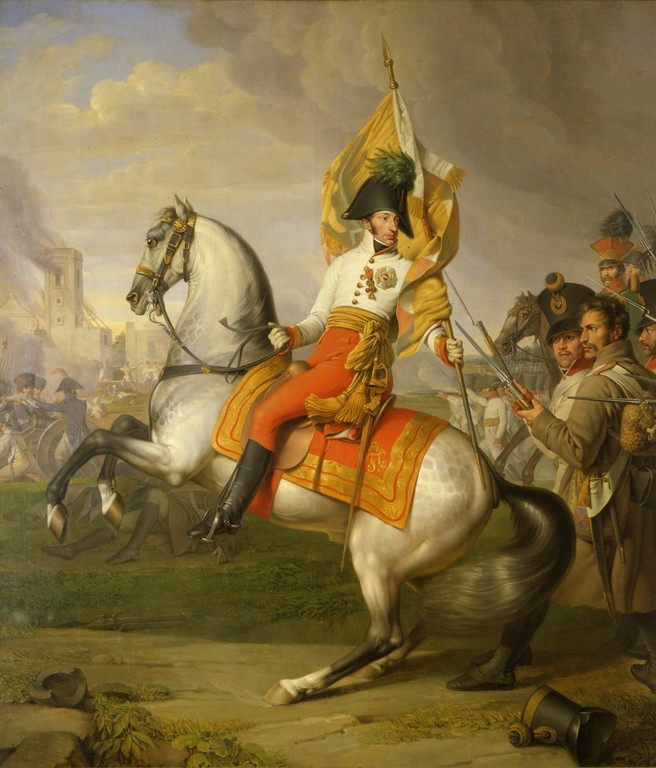
Archduke Charles the best of the Austrian commanders was always hampered by the commanders and politics around him.

can save any un-deployed troops to the end of the deployment phase(very powerful!). The Archduke (Steve) rolled badly and this resulted in Marshal Davout (Bill/me) being able to deploy almost 2/3rd of my force after Steve! The French clearly had the better scouting/intelligence this day!

My plan was to pin/feint on one side where (Steve) had deployed much of his Cavalry force. Then because of my better “scouting/intelligence” use my ability to hold off deploying much of my force until I saw where his forces were deployed, allowing me to concentrate more of my troops against his weaker flank. This would be an advantage for the French provided they were to act quickly, fight well, and have success before the Austrians could effectively react. The Austrian force was a bit larger in Infantry, Cavalry, and Artillery, not huge but enough to make it hard on the French should they make even small mistakes.
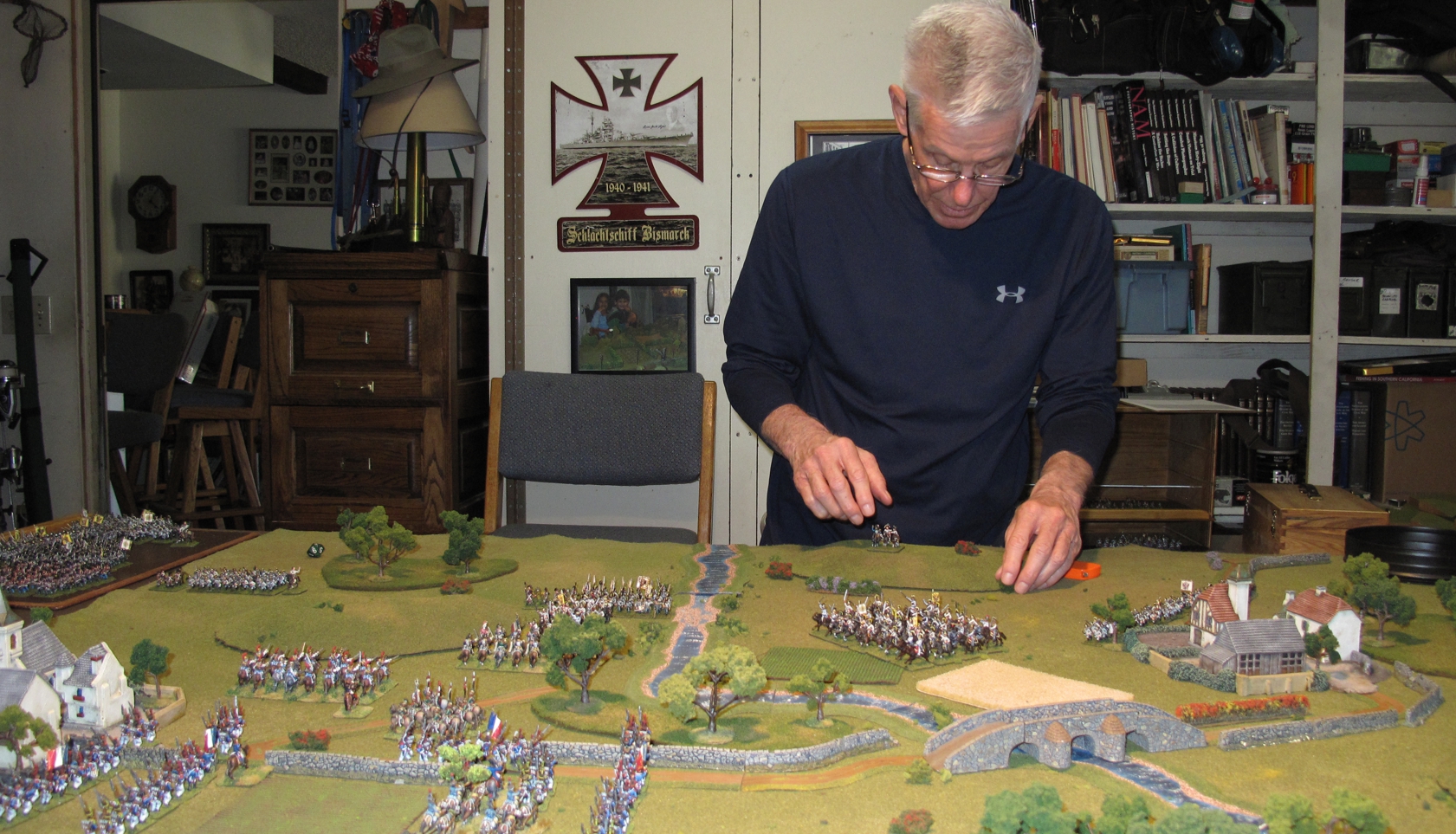
A familiar sight on Saturday mornings on my gaming table…. Steve and a general overview of the battlefield from the French side look towards the Austrians.

My initial plan was to hold the road and village on my right pushing my cavalry down the open area on the of the village, but after the deployment rolls this strategy was changed to an all-out attack on the left and center based on “new” information and I deployed much of my remaining force to accomplish this. This simple process for deployment worked out so well in creating a more interesting battle that I’m at a loss as to why I never thought of it before!

There are several things that I like about it;

  1. It eliminates the “I go u go” deployments that leads to the same old boring heads up fight.
  2. Presents challenges to both commanders other than “roll well and live”
  3. Makes commanders pay much more attention to initial setup and terrain effects.
  4. Makes players think link commanders and consider the abilities of their troops carefully.!

I’m also now toying with a “strength roll” to have a force “weakened, strengthened, or remain the same” and possibly then a secret roll for the opponent to know this fact.

So on to the battle! I have recently painted a lot of French Napoleonic cavalry and wanted to get them into it, many games have Cavalry in them but normally in a supporting or breakthrough roll. I wanted a battles where Cavalry was the main focus.

The forces would reflect his;

French, 28 stands infantry (10,080), 32 stands Cavalry (5,760), 3 Artillery Batteries (16-24 guns).

Austrians, 36 stands infantry (13,680), 42 stands Cavalry (7,560), 4 Artillery Batteries (28-32 guns).

We used “Age of Eagles” rules by Bill Grey (Excellent!) and figures are 15mm primarily Old Glory (French) and AB & Old Glory (Austrians)

The Austrian force was larger for several reasons, Steve’s rolling of dice is less than “stellar”, and I know the rules better! I figured this would give a bit better balance, it did! (and actually, Steve rolled better than normal during the battle) but his roles for initial scouting were abysmal!
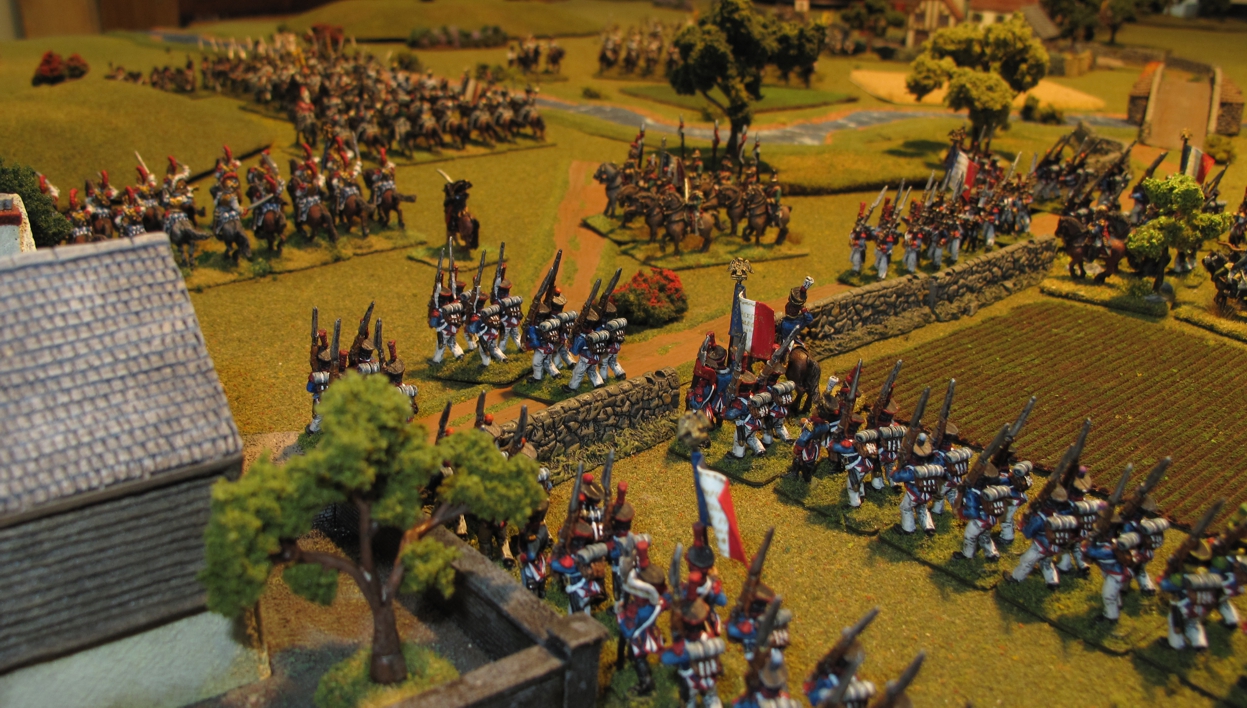
French infantry on the French left flank get new orders and goes on the attack!
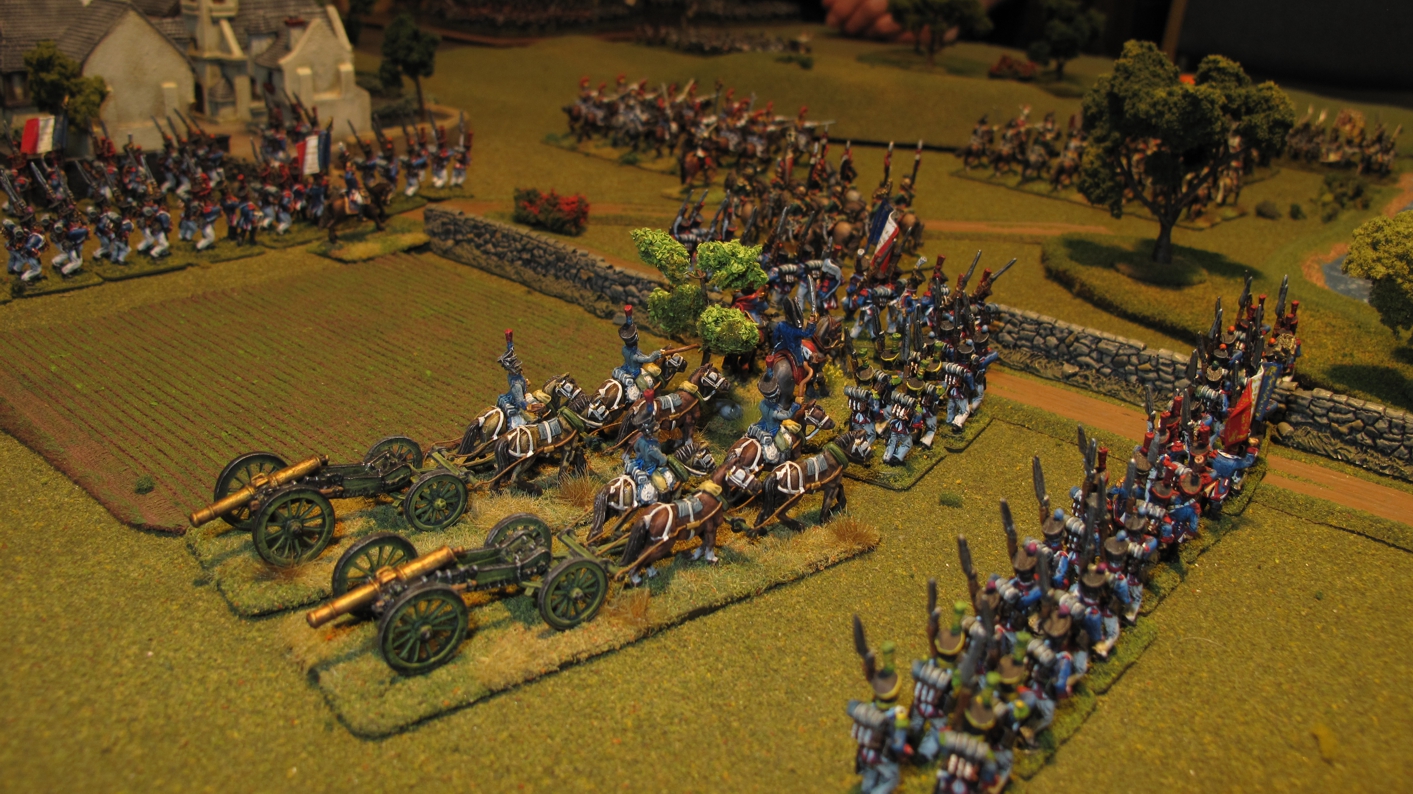
Half of the the French infantry on the left goes into the attack while the other half supported by a battery of “12 pounders” moves to support the French Cavalry in the center.
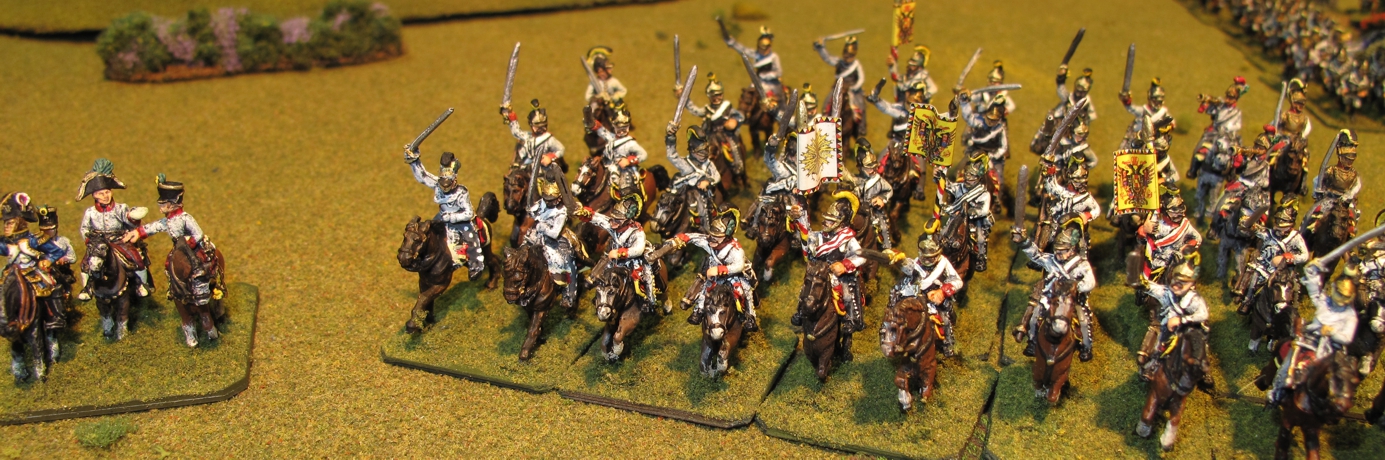
Archduke Charles and his staff quickly recognize flaws in their plan and issue orders to strengthen the center and ad weight to stem the French push on the Austrian right! Austrian heavy Cavalry thunders to the attack!

The “French” plan was simple and very much as Napoleon himself liked to do, threaten the flanks, weaken the center, strengthen your center, crush one flank while your strengthened center prevents or slows their reinforcing the flank under attack. I won the first few initiative rolls allowing me to choose to move first or second and instead of occupying my right flank as the original battle plan called for I pushed my infantry hard on through the town on the left and into some woods in the center, my battery of 2-12 pound guns also moved into the woods. On the French right flank my Hussars and a Horse battery acted as a decoy/blocking force drawing the bulk of the Austrian cavalry and some of their infantry away from the middle.
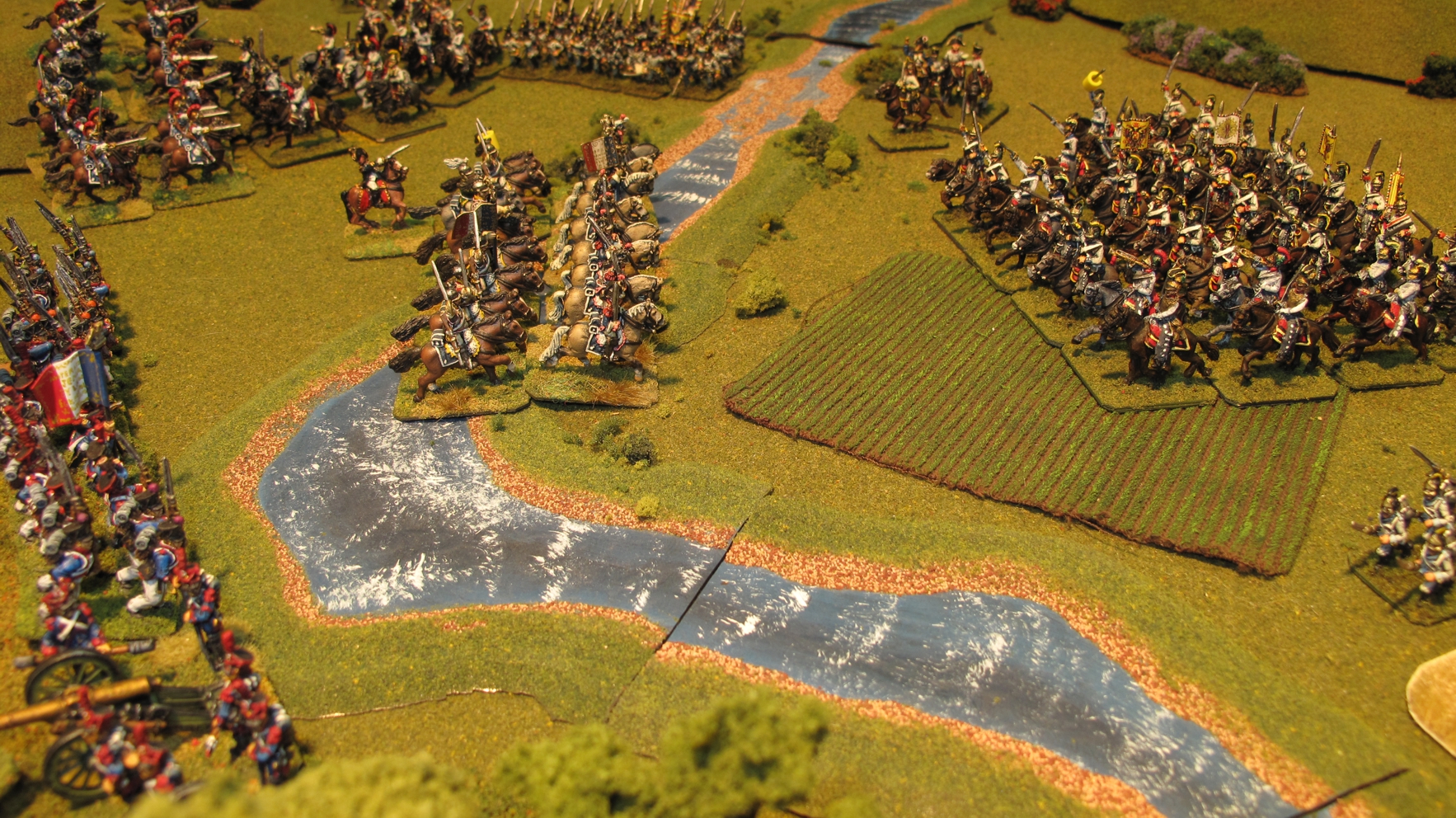
Because of some poor activation rolls on my part I have to send in my French Cuirassier early to prevent the Austrian cavalry from charging my still deploying infantry and artillery. Realizing the importance of this charge their commanding officer goes with them! In the upper left you can see the French Carabiniers already engaged with the Austrian Dragoons, a fight that would see saw the entire game!
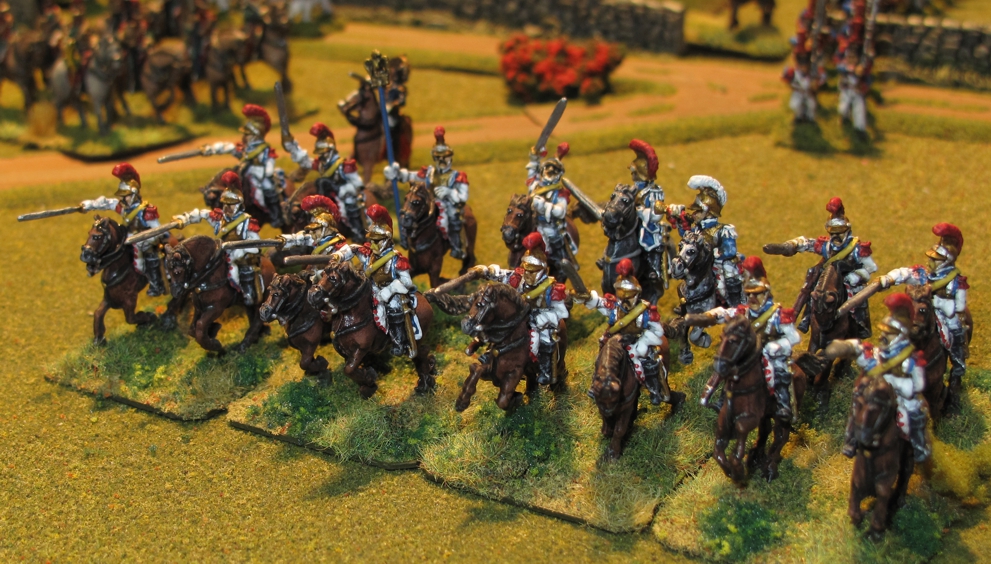
My French Carabinier fresh off the paint table make a great showing in their first battle…well they held their own stemming the tide of Austrian cavalry just long enough, and finally shattering the Austrian Dragoons! That fight went at least five rounds with the Austrians giving a great account of themselves until the end.

The battle went pretty much along those lines but was touch and go many times. Archduke Charles made several timely adjustments to his forces and rolled his dice rather well while I as Davout, had a good plan but rolled more 1s and 2s than usual resulting in my forces being a bit sluggish in getting to their positions. The battle that followed was just dam fun with a large cavalry fight occupying the center of the map for the entire game. Austrian Dragoons, and Cuirassier, exchanging charges and counter charges with French Carabiniers, and Cuirassier. The number of charges, counter-charges, retreats and reforming were amazing and made for a very exciting game with neither side getting the upper hand until the last turn when what was left of the French Carabinier routed the Austrian Dragoons.

The French left flank had all the infantry and the heavy foot artillery. These four brigades pushed into the town and deployed on both flanks of the cavalry battle to their center. Two brigades and the Heavy artillery deployed along some woods where they could threaten the Austrian Infantry and Cavalry trying to reinforce their right flank. The other two French infantry brigades supported by a small unit of French Lancer Cavalry pressed on to attack and crush an Austrian Infantry brigade and Artillery battery holding that flank.

The French right flank (Austrian left) was held by two French Cavalry units, the 5th Hussars and the 13th Chasseurs a Cheval, along with one battery of horse artillery. Opposing them were two Austrian Hussar units, a unit of Austrian Dragoons (these Dragoons were almost immediately sent towards the center) and a horse battery. The French put on a brave front and let the Austrians get just close enough but not within charge distance before retiring behind a small hill. The Austrians followed for several turns finally splitting their Hussars around the hill in an attempt to cut off the Hussars retreat. Once the Austrians split their force the French 13th Chasseurs a Cheval about faced and charged one of the Austrian Hussar units badly mauling it, Killing some, capturing others (as well as their commander) and routing the rest! (Bill rolls well!) The Austrian hopes of flanking the French in the center were dashed as now French had their horse arty and the 5th Hussars covering the bridge in the center while the other victorious French Chasseurs pushed back around the hill the threatening the remaining Austrian hussar unit from the rear.
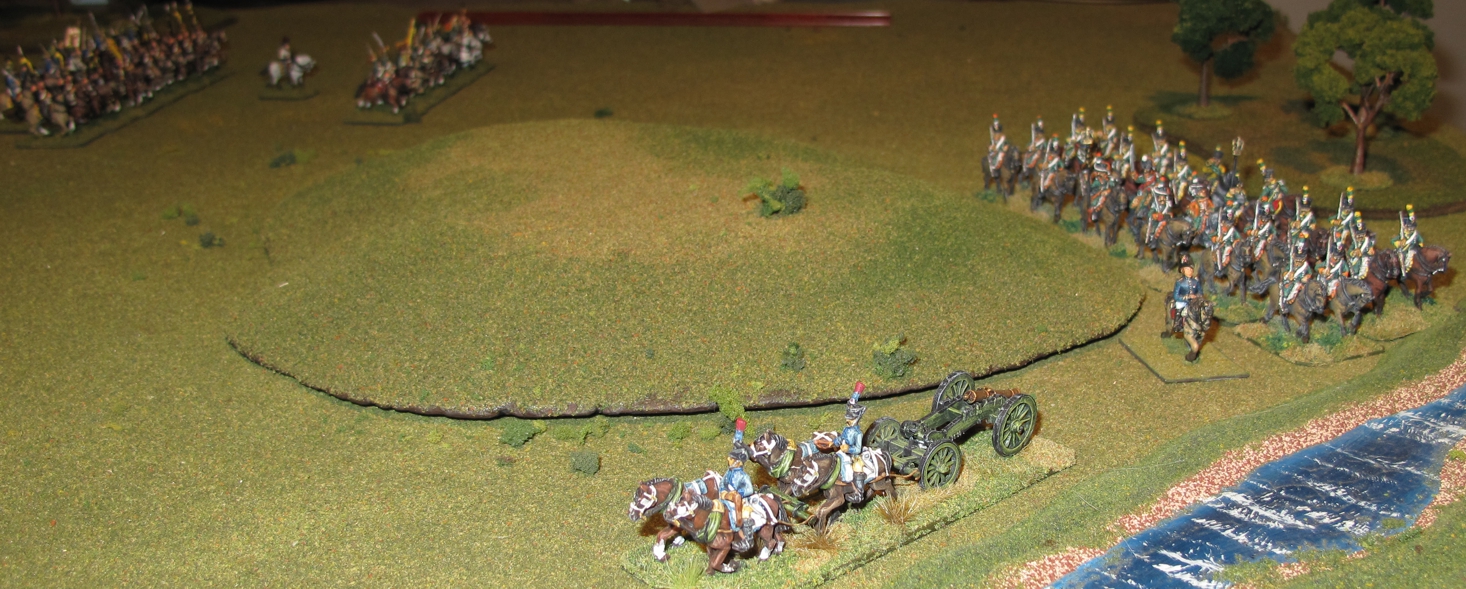
The French Hussar and Chassuers move off refusing battle further splitting the Austrian forces a turn or two later they would turn on one of these separated Austrian Hussar units and shatter it!

On the Austrian right the French infantry crushed the unsupported Austrian infantry killing or capturing hundreds, some standards, and a battery of guns. The center battles also ended in the favor of the French with over 1,000 prisoners, and an Austrian Cavalry general captured, the rest routed or were unable to press the fight any longer. At this point Archduke Charles realized the battle was lost and ordered what remained of his Cavalry to cover the infantry and guns retreat. The French Cavalry pursued the Austrians until nightfall when both sides bedded down for the night wondering what the morning would bring. Marshal Davout looked with satisfaction at the lines of Austrian prisoners filing past his headquarters and the standards lying at his feet while writing his report to the Emperor, Archduke Charles rode on into the night once again wondering where and how he could turn the tide……
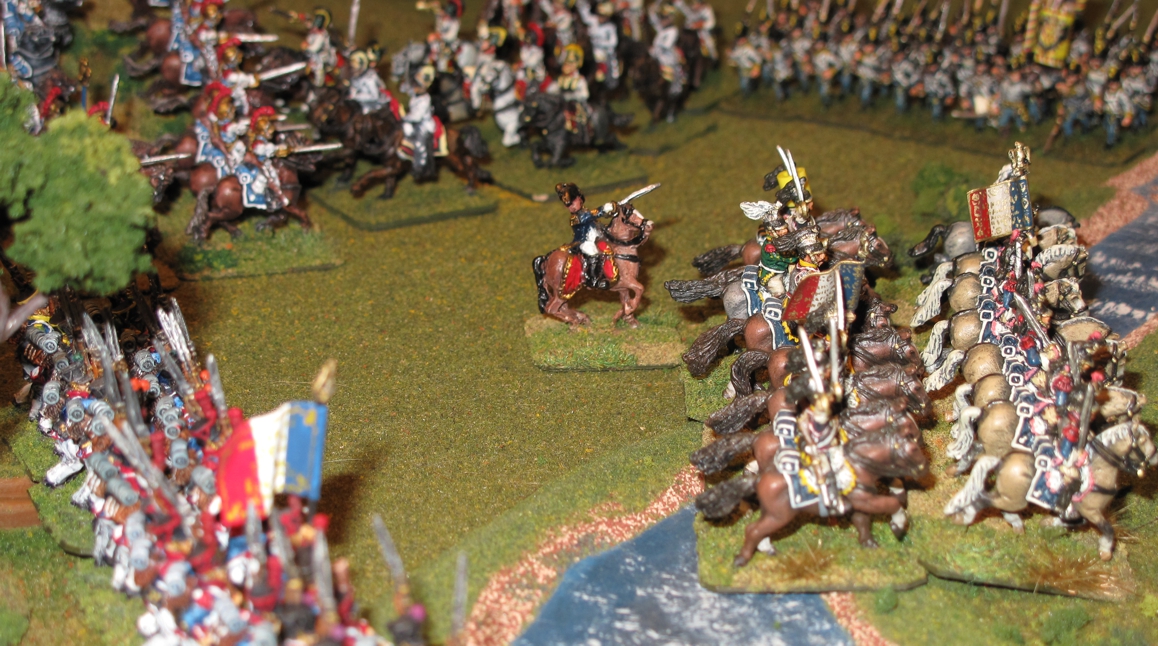
The French Cavalry General shouts to the slowly forming infantry “Quickly comrades! We will make time for you!”
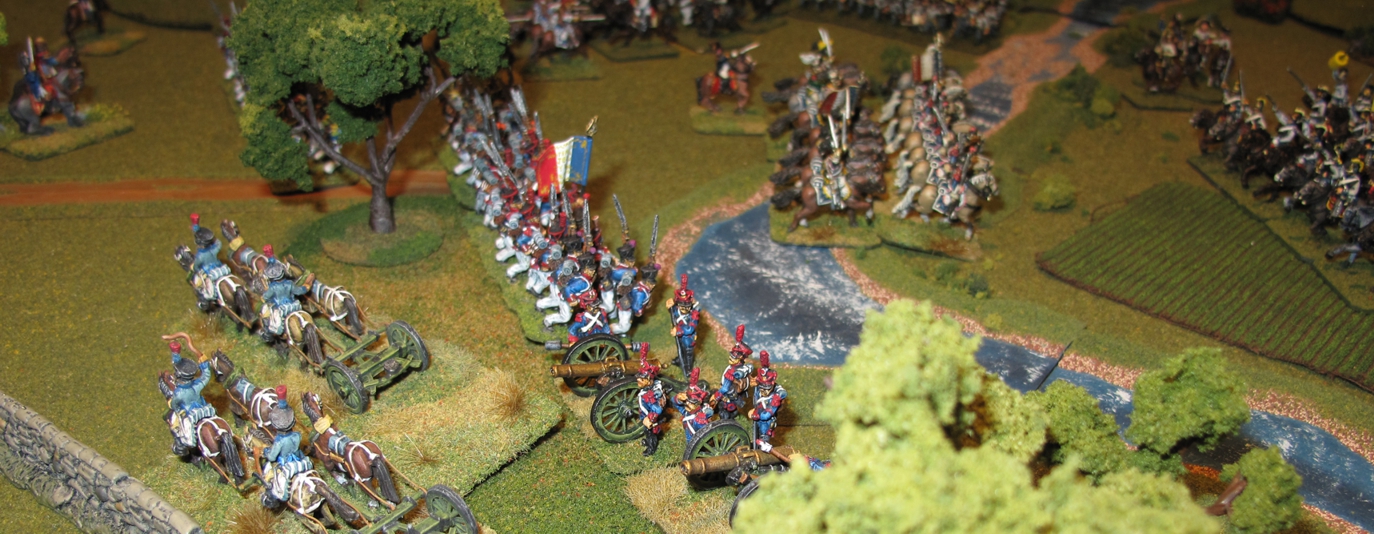
French infantry and guns deploy.
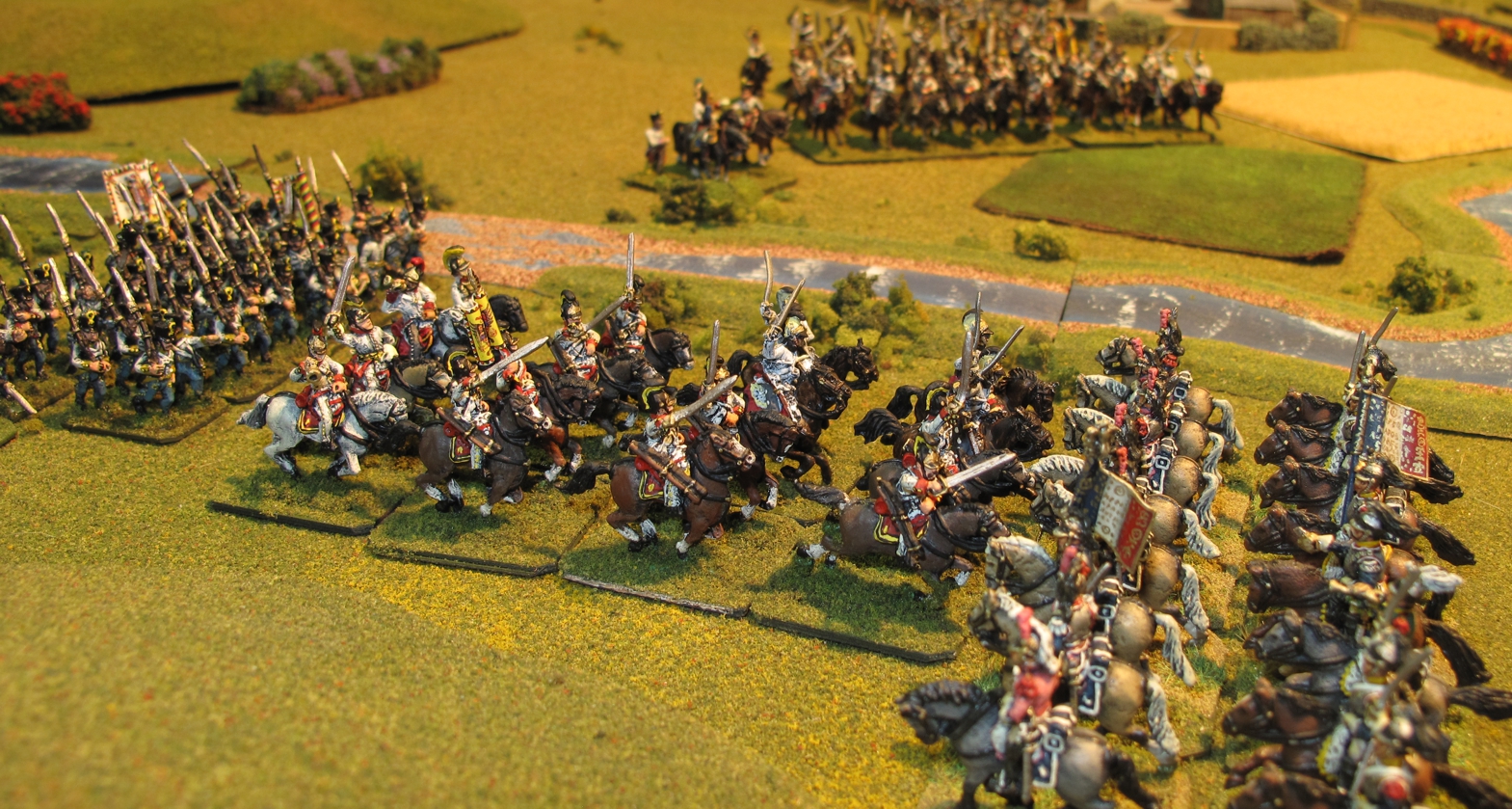
This battle found roles reversed, infantry now playing the supporting role to cavalry! This is the first clash of Cavalry early in the battle the Austrian Dragoons (the heroes of the battle on the Austrian side) take on the French Cuirassier, briefly defeating them and causing the French cavalry to retreat (they later take on the French Carabinier! who finally defeat them)
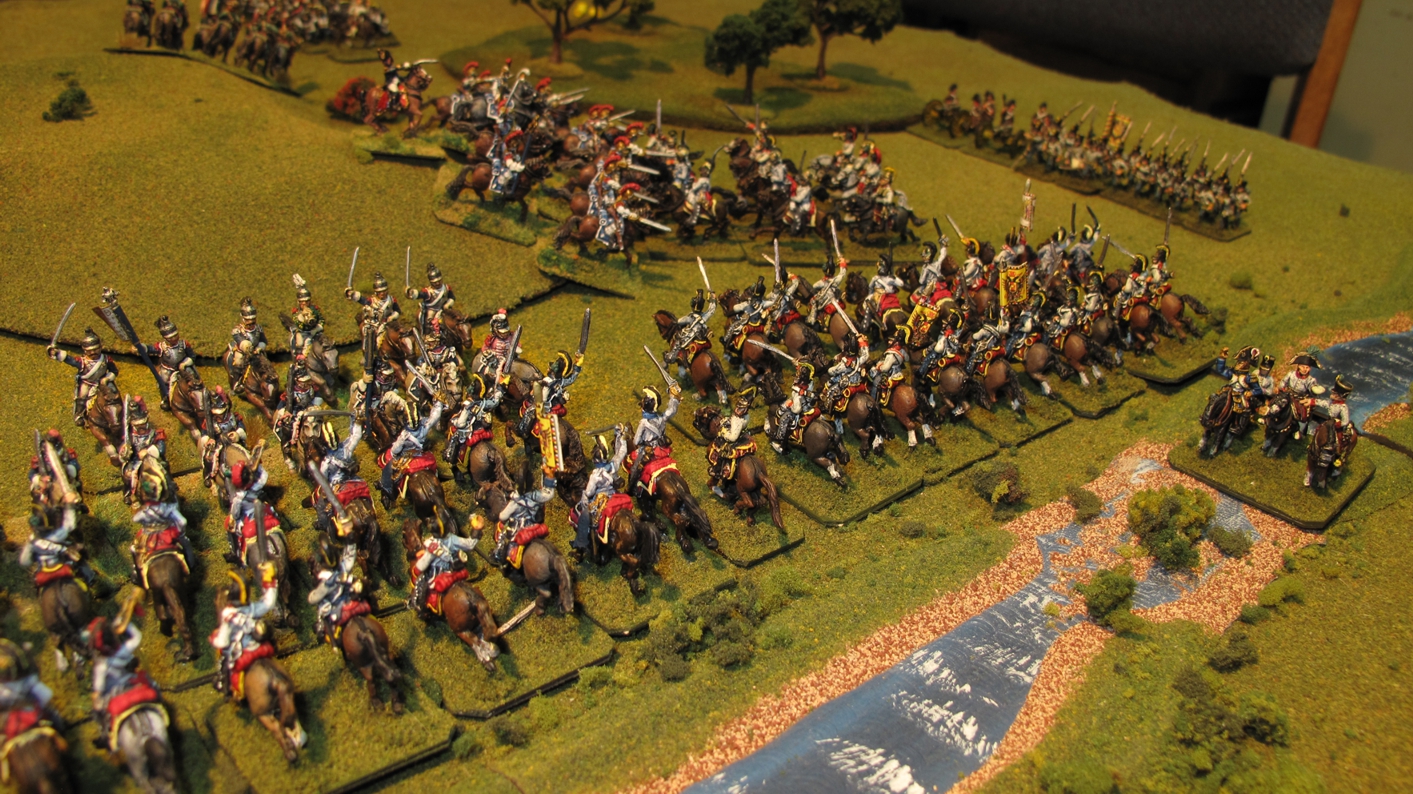
The high water mark for the Austrians with their cavalry crossing the river and pressing the French hard!
 

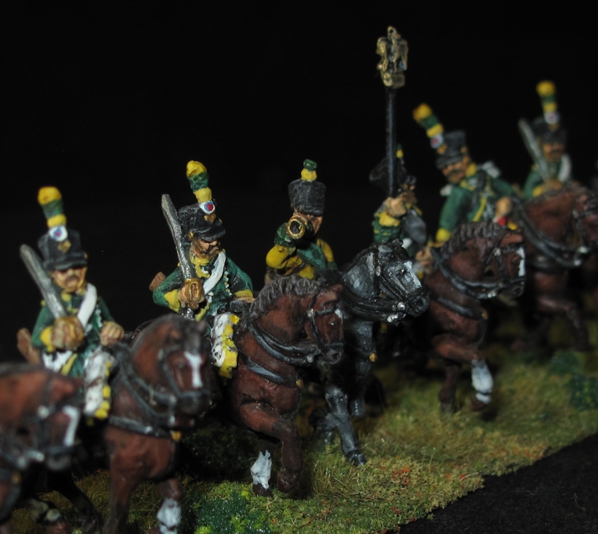
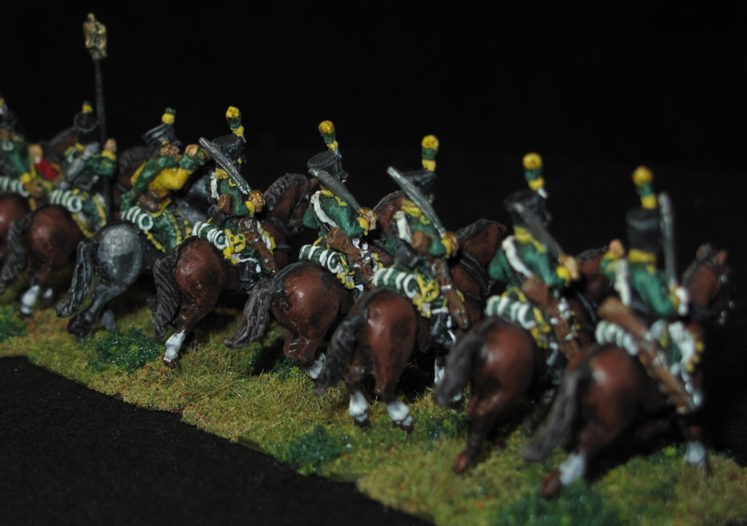
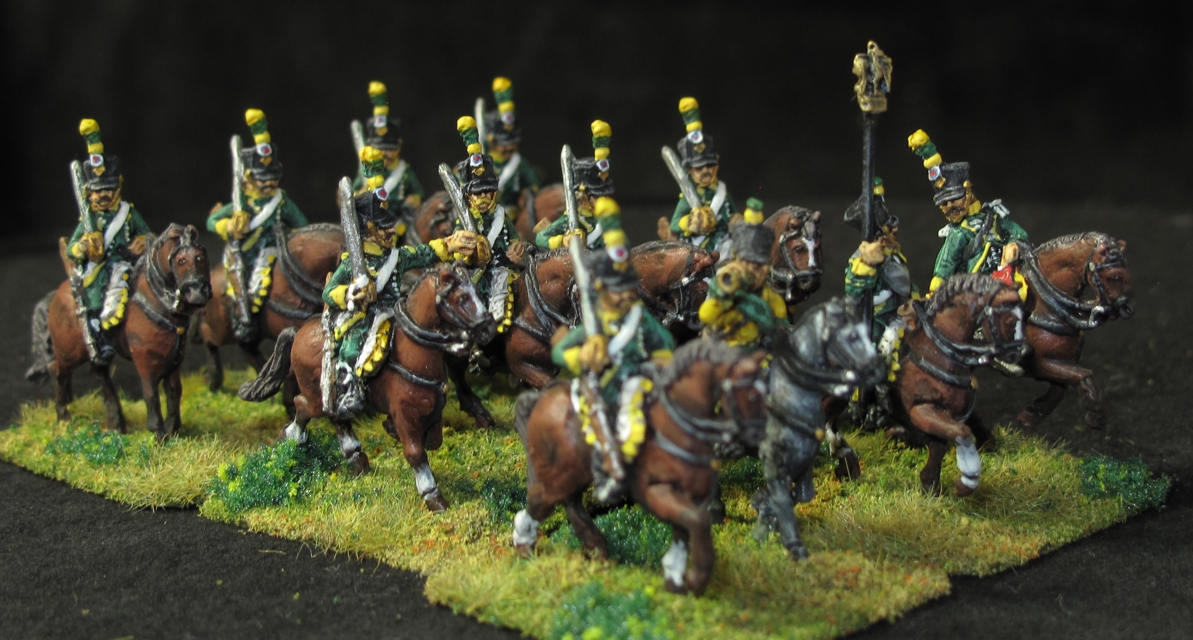
Napoleonic Chasseurs a’ Cheval

Light Cavalry the “eyes and ears” of the army! (remember all pictures are “clickable” for a larger more detailed image!)

There is something about the Napoleonic period that has always fascinated me. I think it’s a bit like my fascination with feudal Japan the period of Sengoku-jidai  (The Age of the Country at War) where war was raised to almost an art form, truly “The Art of War”. Uniforms, dress, tactics, and weapons remained basically the same for a long period of time but were honed to a fine edge. I love painting miniatures, but both Feudal Japanese and Napoleonic figures hold a special joy in painting for me!

I recently decided to toss a paint brush and some time at reducing my 20+ pounds of unpainted 15mm Napoleonic figures as well as retire some ebay units to be replaced by units painted by me. Since much of my early gaming in the Napoleonic period was done using “mercenary units” standing in for Cavalry units I had not painted I figured that was a good place to start. Looking into the “Napy box” showed I could use some more light cavalry, in fact I had only one small unit of Chasseur’s a’ Cheval (and that was painted by my friend Stevie G over 25 years ago!).

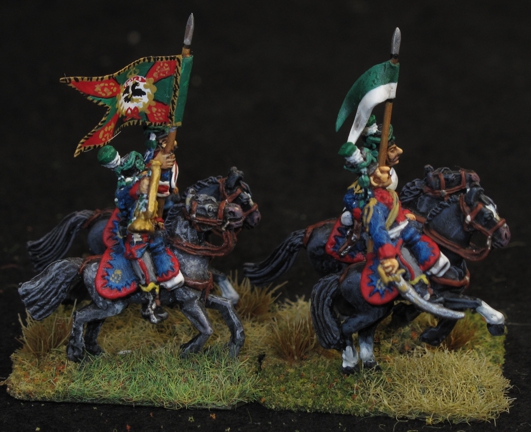
I’ve always been a fan of “Old Glory’s” original line because of the cool poses! This officer looks to be saying something to the “Eagle” bearer, perhaps “Good luck Monsieur Barrett, once again we seek glory for France!”

Most of my Napoleonic figure are from 19th century miniatures (former Old Glory line) as I think they have not only one of the most extensive lines, but their variety of poses within the pack is outstanding. The sculpts are on the whole excellent, casting good, and in the hands of a good painter look very good as well (like most figures). I feel the figures  are much more dynamic as well, charging figures really look the part, even “at rest” or “in reserve”  figures look like they are getting ready to jump in the fight not the “trotting on the parade ground” pose you see in some figure lines.

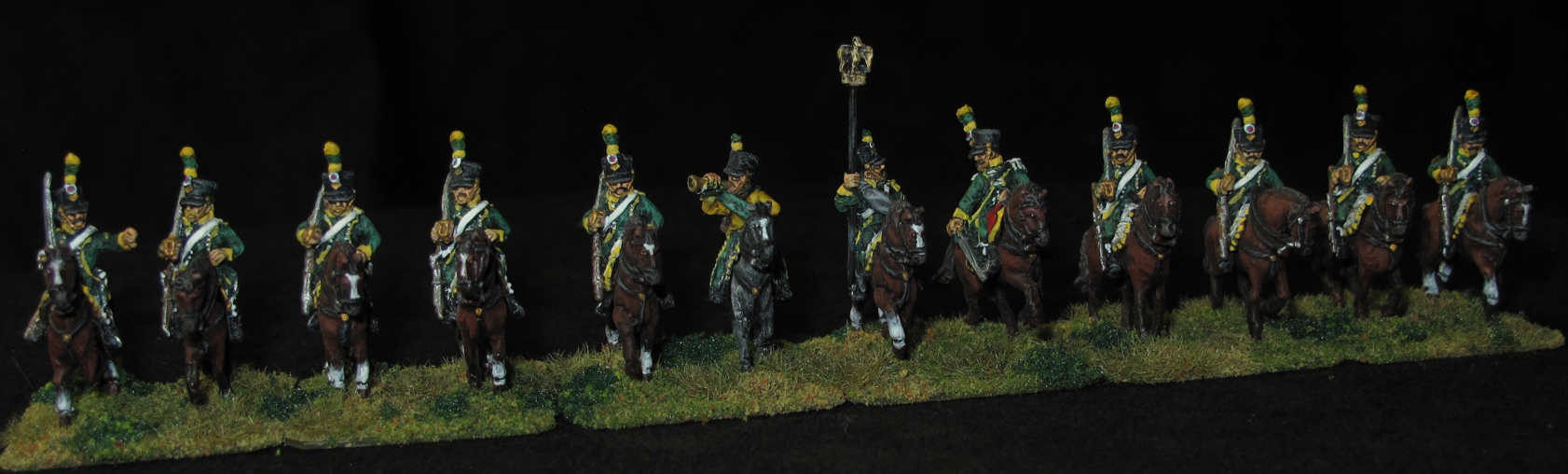
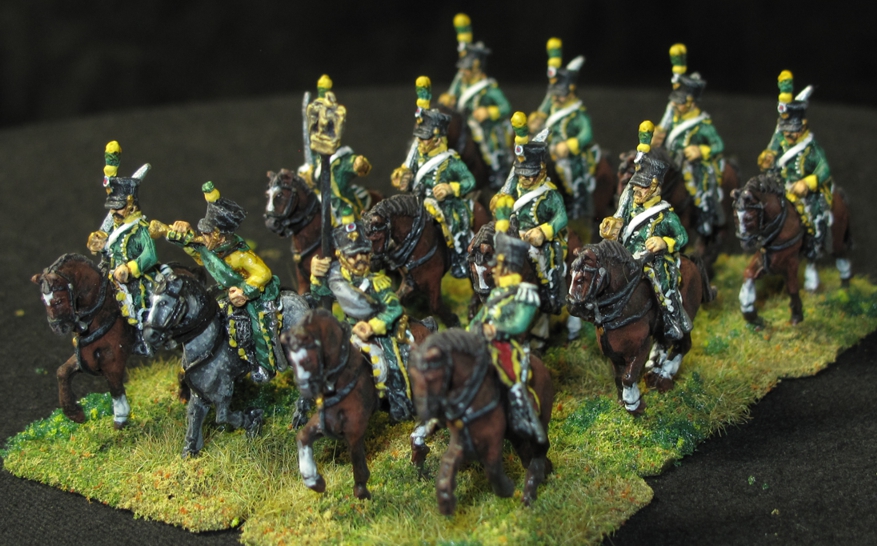
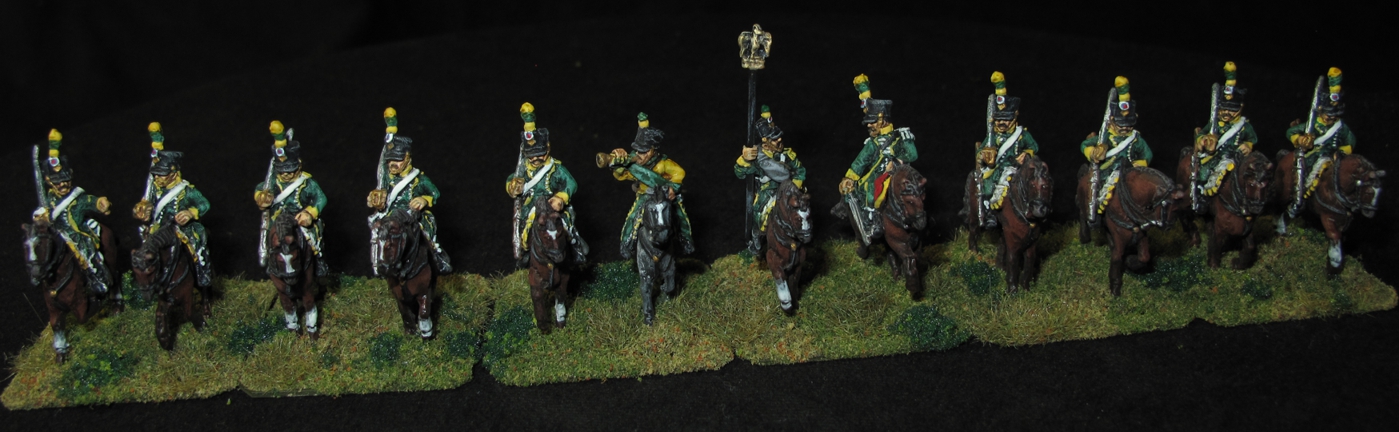
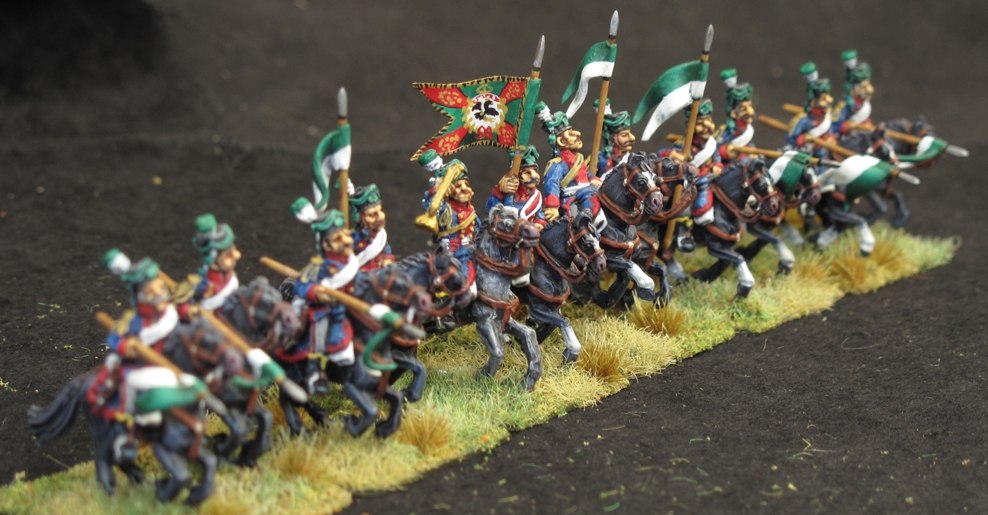
I started with 24 figures, to be split into two groups of twelve, resulting in two six stand units based for the Age of Eagles rule set. The unit Steve had given me years ago was painted as the 13th Chasseurs and as an homage to him (he started me in Napoleonic’s) one-unit world be painted in the 13ths Chasseurs colors while the other would be modeled after the 4th Chasseurs a’ Cheval. Here are the 4th Chassaeur’s a’ Cheval. Stay tuned for the 13th Chasseurs soon to follow!

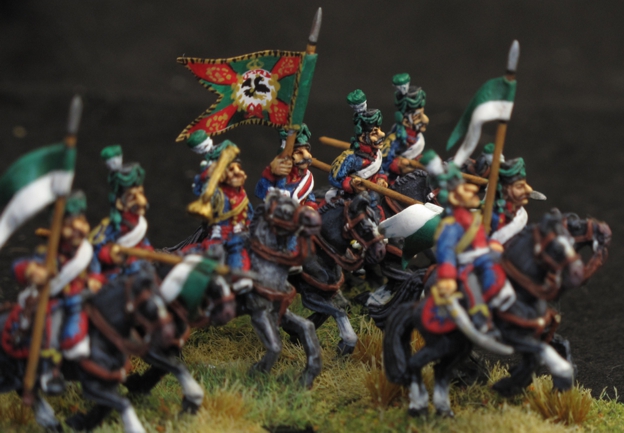
Napoleonic figures are I feel some of the hardest figures to get the uniforms correct simply because of the detail, complexity, and changes that went on over the period. The research can be frustrating and mistakes will be made even with exhaustive research by the best painters… I have made a few “simple ones” in these figures, can you spot them?

Horses are always tough to make look real. Over the years I think I have learned to do a fair job. Here we have the proverbial “Horse’s Ass!”

Lined up in “Attack Column” ready for the Emperors command! If you click and expand this picture the face of the horse in the back on the left is quite comical. He seems to have an expression of “good lord! not again…cant we all just get along!”
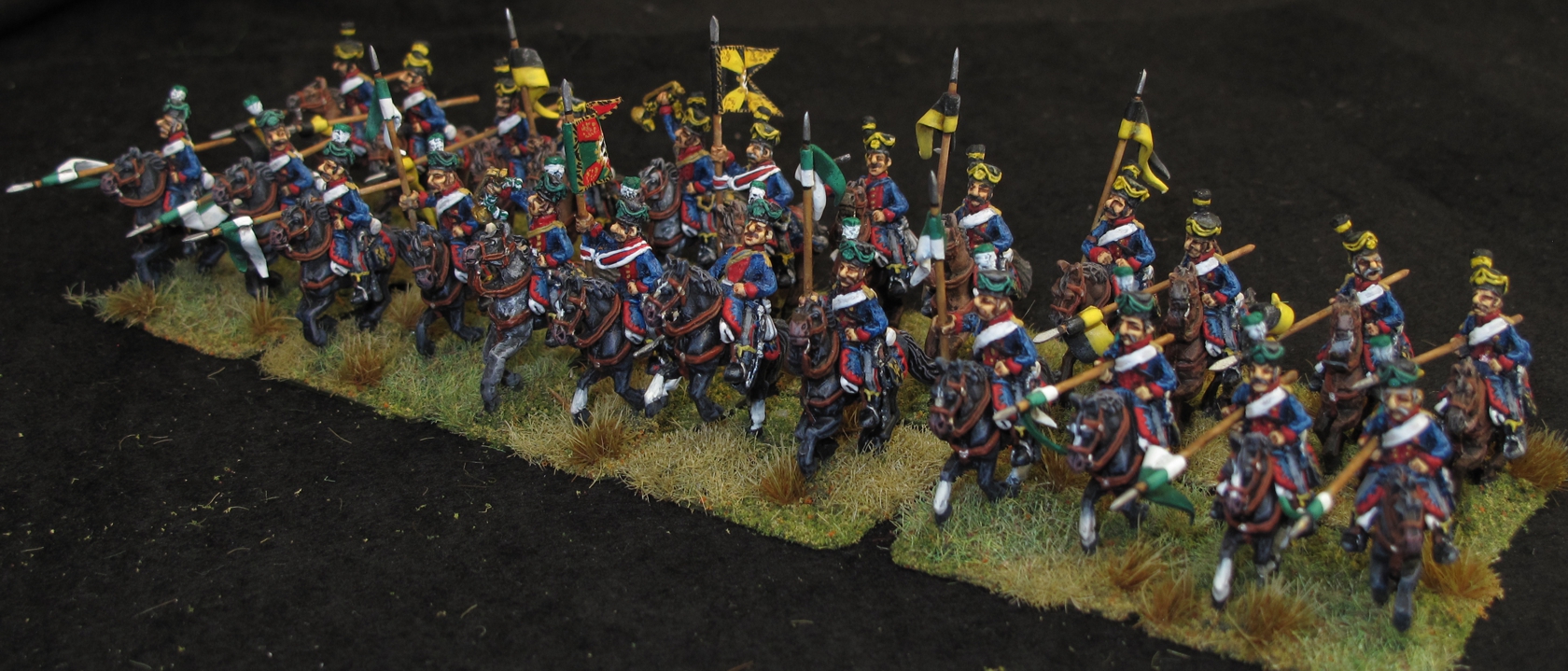
15mm Prussian Cavalry “Towarczys”

It seems that as of late I have been doing more painting but haven’t reduced my lead pile at all since I have continued to buy more for myself and all the painting was done for friends! Both enjoyable none the less!

The current project was for my long time gaming buddy Stevie G and a couple of Napoleonic Cavalry units. Steve has a big Prussian force and recently picked up some Prussian “Towarczys” Lancers from Boki miniatures out in Estonia! They are some of those troops that are rare from a collector standpoint but look awesome on the battlefield.

They are going to make a fearsome looking unit on the battlefield! Makes me wish I had Prussians so I could keep them for myself!
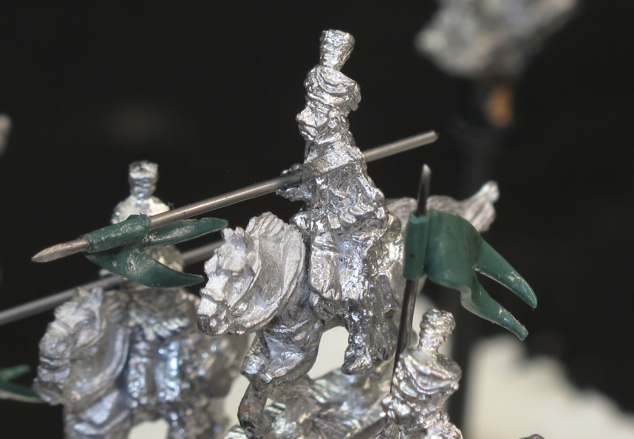
The minis are well sculpted with lots of details and are both fun and easy to paint. The casting is a bit off requiring some work in cutting out bubbles and filling some poor cast areas. I believe the problem is that these are gravity cast and not done with a spin cast machine. Its just a small chore and not really a big deal. The minis do not come with horses or lances. Horses from either AB miniatures or 19th Century Miniatures work well, I used horses from Old Glory 15’s (19th Century Miniatures) and though a bit less beefy than the 19th century horses on average I think they work well as eastern European horses tended to be smaller than their western European cousins.

Next were the “lances”, they don’t come with any, not a problem for me as I replace ALL my flag poles, spears, and lances, on all my figures with STEEL! Over the years I have gotten pretty good at this and make some nice looking replacements. That how I got hooked into painting the figures by offering to make the lances and do the pennants for them as well.

Stevie G like I mentioned before is a long time gaming bud as well as the two of us being “grips” in the movie biz in Los Angeles. We have spent many a long day/night together on sets, Star Treks, Profiler, Charmed, and more, passing them time between shots talking miniatures (on Deep Space Nine we spent our lunch hours painting minis right on the set!) Steve has a heart of gold and has always jumped whole hog into any type of miniature wargaming that I dragged us into so the more I looked at the figures and worked on them the more I felt like going the whole way “prep to paint” with them. I felt it would be a great way to thank him for all the support and friendship over the years.

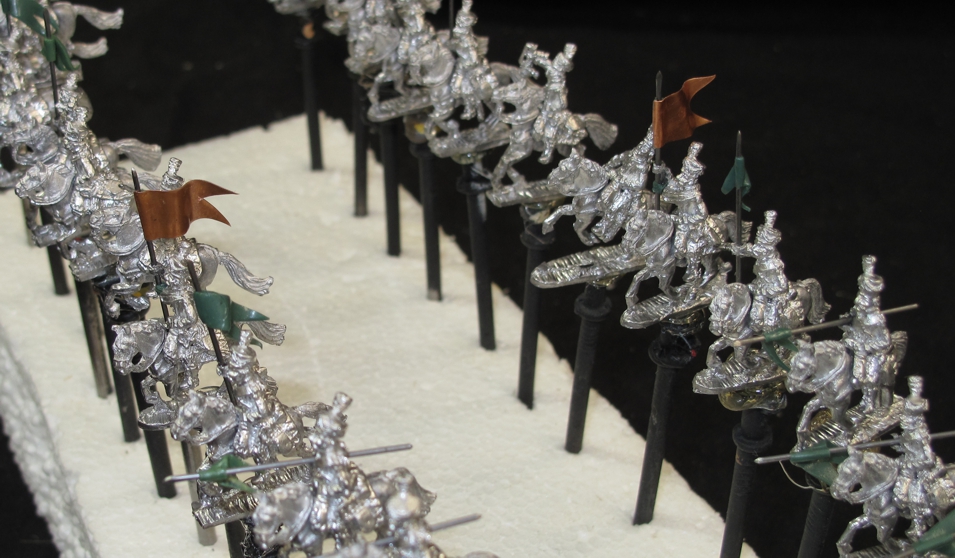
The first stage was cleaning and matching the horses and riders. I always carefully look at the riders pose and position, then select a horse that matches action wise. In other words don’t put a lance down charging figure on a horse that’s standing still! I also look at the figures and try to get as many varied poses in the unit and space repeated poses out to make them less obvious. Sometimes small mods can help with this, same rider different horses, bend a sword arm, cock a lance, and gently twist a head. Then since these riders and horses were from different manufactures I took time to cut and file both the back of the horse in the saddle area and the rider to get a good natural looking fit.

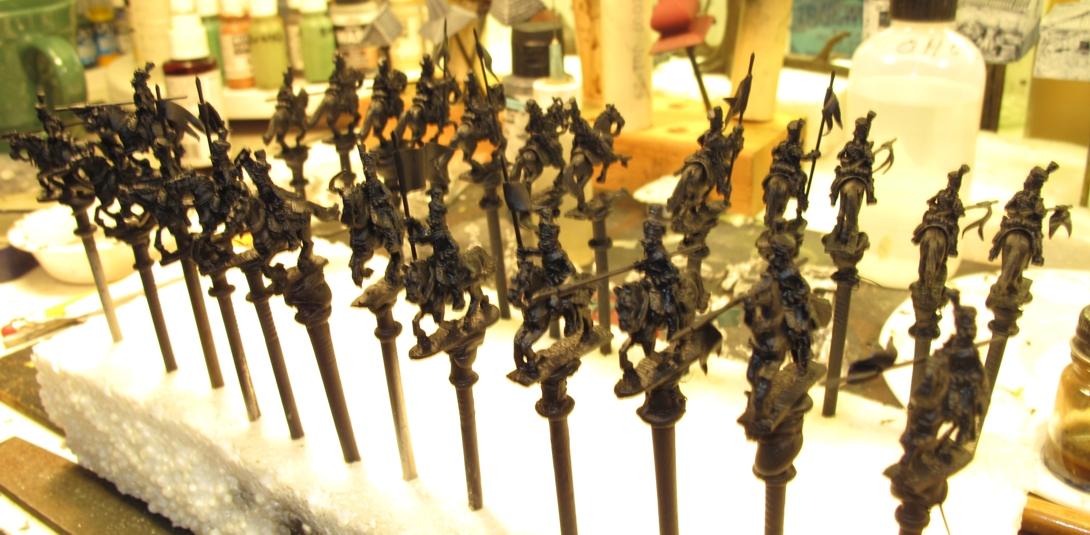
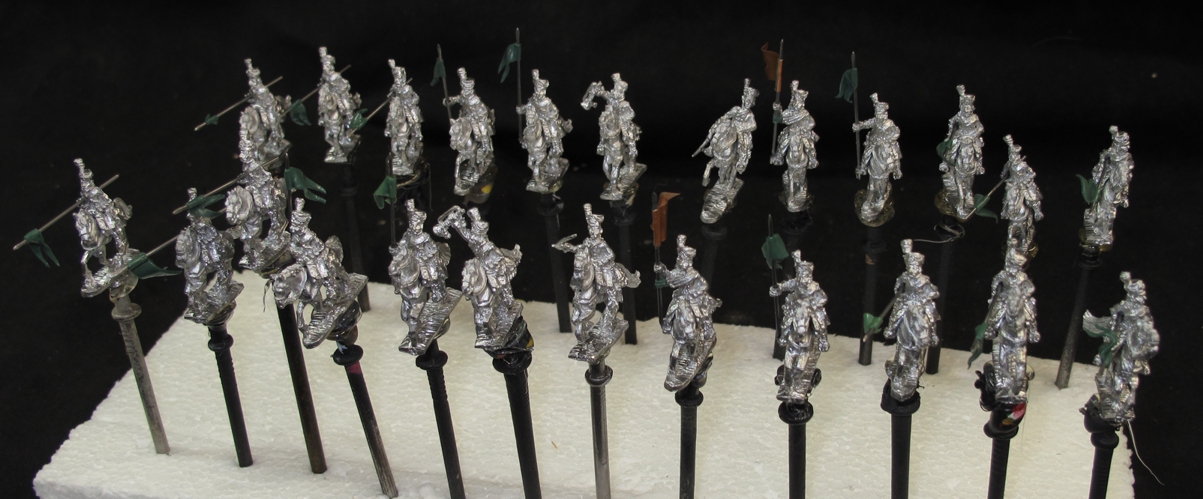
Hot gluing the figure to nails is something I started doing 30 years ago as an alternative to the common practice of gluing them to Popsicle sticks. A chunk of Styrofoam is used as a base…easy peazy!

I always assemble the figures into the unit and determine each figures position in the unit before painting. This can help give the finished unit a more cohesive fee. I might have a figure that is pointing complimented by selecting a figure that has his head looking in that direction, have charging or running figures on the same stand, charging figures in the front, etc.…

They were a lot of fun to paint and work on!

For a larger view just click on the picture!

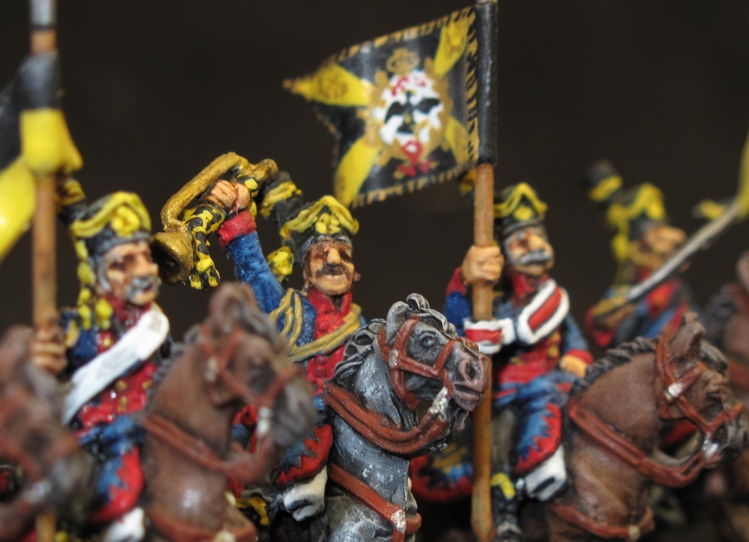
Flags are something I added and perhaps were not historically carried but they look good and heck this is wargaming!

Unit colors were selected from text of one of Knotels prints from the excellent books by Elting on Napoleonic uniforms

I’m really happy with the way the poses came out. I think the units have a very dynamic feel, truly looking like they are just laying down their lances to begin a charge!

Black primed with Vallejo primer and ready for paint!

What figures are those?

“Who makes that miniature? I want one!” Most of us who game have heard that countless times and we reply “oh so & so miniatures out of England” or “such and such minis in New Jersey”. Some of us answer this way “I did” because we either did the figure from scratch or modified an existing figure.
Compared to 30 years ago when I started gaming the selection of figures, terrain, and miniature accessories has grown to a point where even some of the most obscure armies and periods are easily found and, in several scales, things we before only imagined are now found with just a few mouse clicks! For most people this is great, wonderful, but there are still quite a few of us who like the scratch building and customizing side of the hobby and that many times creates the problem that now commercially produced item do not fit the bill. When this is the case, for me out comes the saws, drills, sculpy, kneadite, green stuff, x-acto knives, and all the different materials and tools the scratch builder uses to bring his imagination to the table.
I thought for this post I would just toss up a few of my recent conversions.

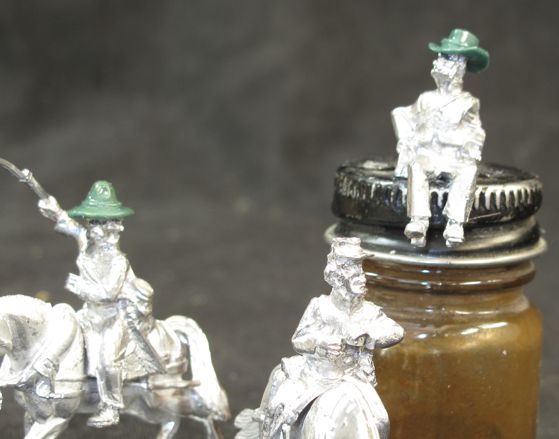
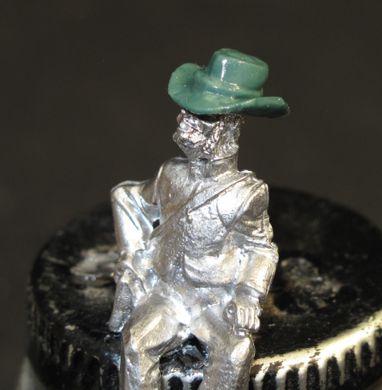
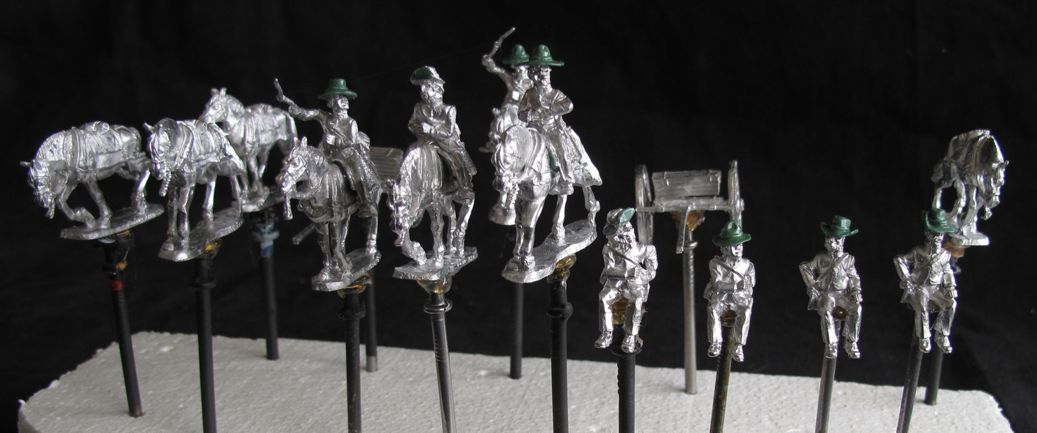
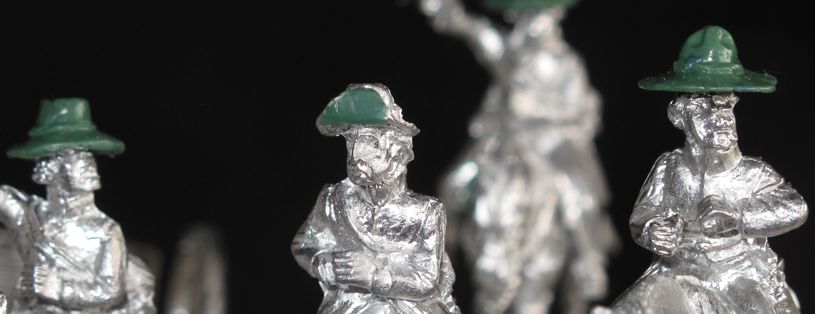
These are 28mm “Old Glory” figures from one of their American Civil War packs. My buddy Steve has been painting a US force for use in battles from around 1880 to 1910 (Spanish American War to the Boxer Rebellion) and wanted some artillery limbers for them. He found some ACW limbers that would work but the figures all wore the Kepi style hat that would be wrong for the period. I took up the challenge to modify them with new headgear.

They came out better that I expected and only took about 15 minutes each to do.

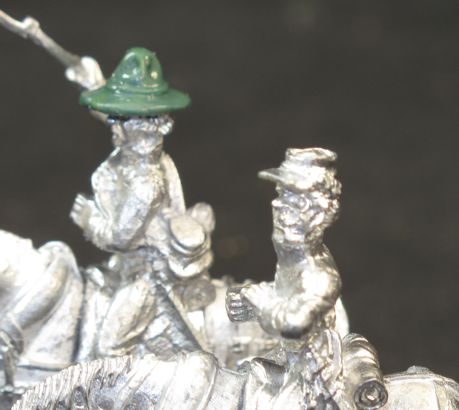
On the right figure with “Kepi” style hat still in place. On the left, Kepi cut off and sculpted replacement.

The “Western” style wide brimmed hat was very popular with the troops in the sunny hot climates.

I think the hat conversion gives them the feel and look of a late US artillery crew.

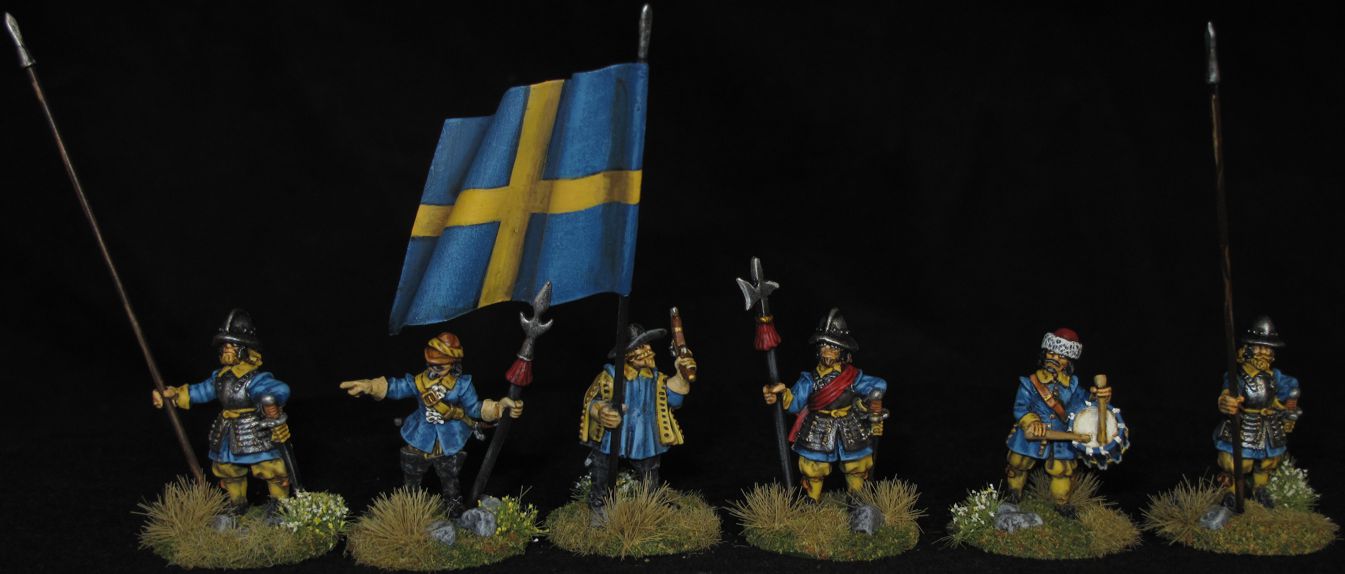
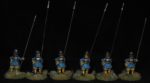
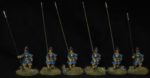
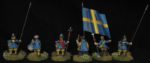
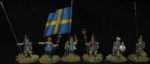
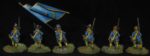
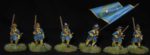
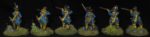
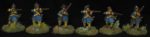
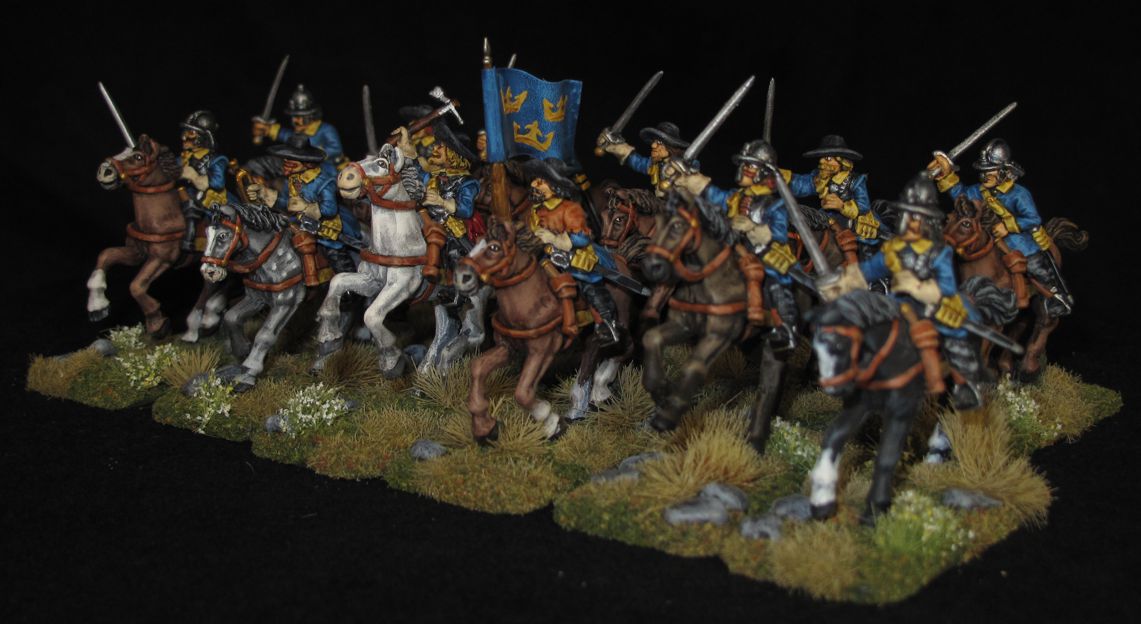
Figures for a friend, Swedish Warband 1650

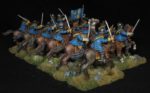
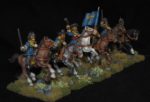
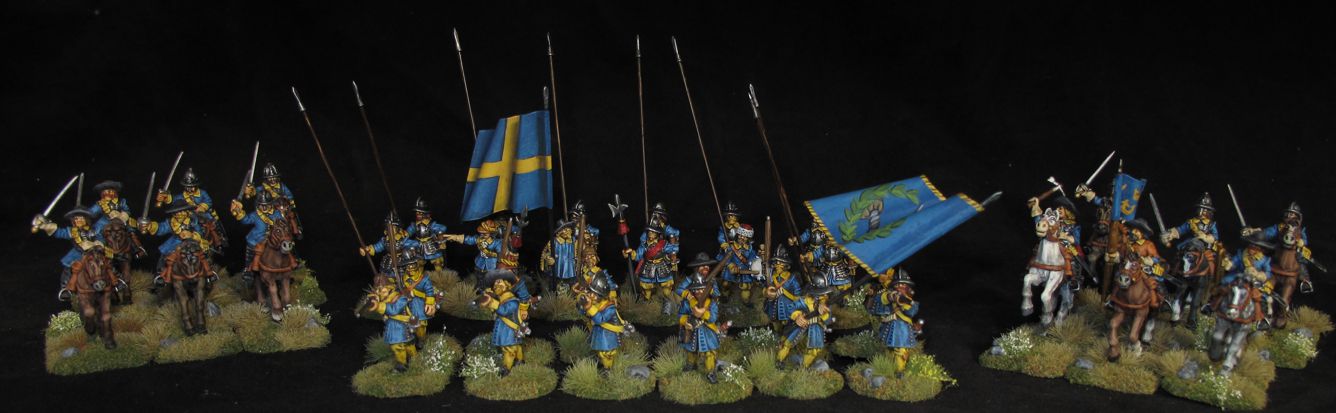
Ready to defend Swedish soil or perhaps add a little! I think they have a very distinctive look easily recognized on they battlefield.

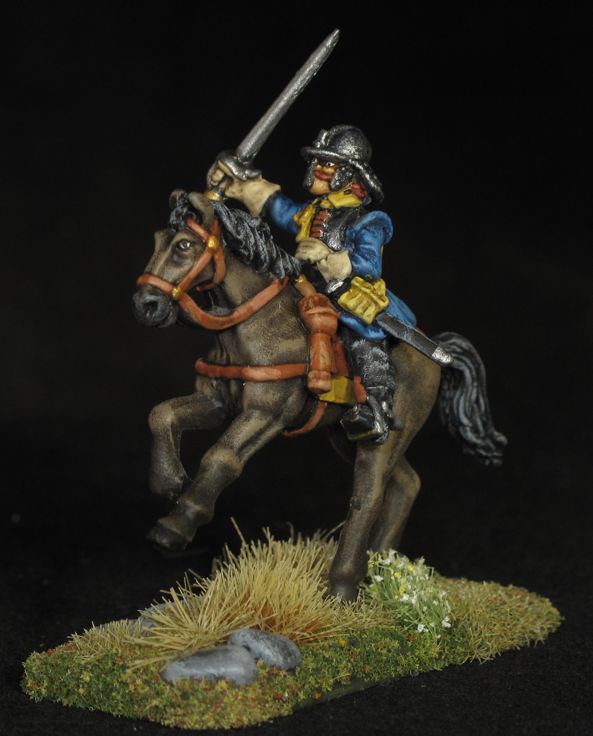
I rarely paint for hire, then if I do its for a friend who wants “Something special” and when one of the “Dogs of War” gaming buddies Frank asked several times to think about painting his Swedish Warband for use with the “Donnybrook” rules system I hesitated to do it. I looked at the figures from the “Assault Group”, 24 infantry, 12 cavalry he had already purchased, they were very nice, well-proportioned and sculpted. These were no “old Glory” figures, these would paint up well but would show any mistake or lack of care. In other words, they would look great if painted well, short cuts would show with these unlike “rougher sculpted” figure types. I decided that the cash generated from the commission would slide me into my 28mm Samurai Warband figures from the Perry’s nicely, so I agreed.

For a long time I have dreaded painting horses, tough to make look “alive”, I think over the years I have developed a style and method that accomplishes this and is almost “fun” for me to do!

There was also going to be quite a bit of custom work involved, hand made pikes, pose alterations, and custom flags to be made. I also do very custom bases on my figures and when I paint for others it’s a complete “head to toe” job, flag tip down to magnetic base. I don’t want a great looking figures sitting on a so-so base! I take quite a bit of time on figure prep and finish since I think the majority of figure painters and especially sellers don’t! I have seen quite a few mini’s in my day and lots of friends have purchased figures to flush out their collections. The vast majority of these figures are not prepped properly or coated and sealed after painting resulting in wear marks from handling, spears, swords, and other pieces breaking off, and the flocking and basing looking old and worn very quickly. Cheap figures ALWAYS have a short cut involved, that’s why their CHEAP. A good automotive primer sprayed on and left to dry for 24 hours is best. Sealing with at least two coats of GLOSS COAT is a must, DULL COAT is NO protection! Let the Gloss coat dry for 12 hours, less depending on weather (dry and hot out) or speed it up GENTLY with a warm blow dryer! My figures and much of my terrain has been done this way and you can take my stuff to the sink and gently was off dust with cool water and a soft brush! If need be.

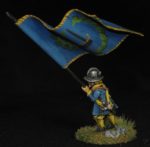
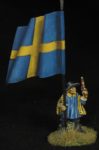
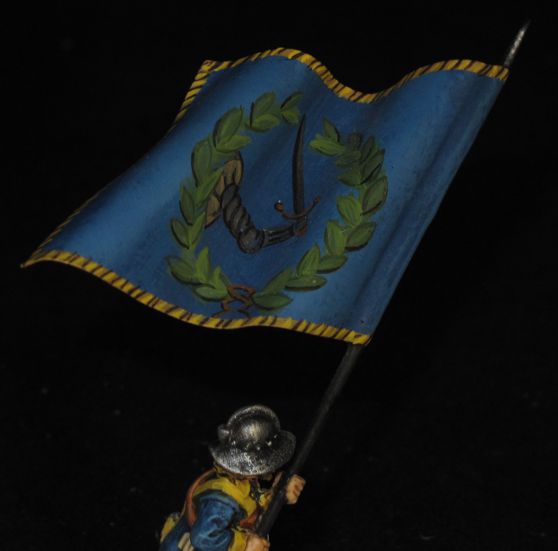
I make my own flags, copper sheet, and handpaint them, I think for better or worse its now a completely “painted” figure.

The job was tough but it was also fun! It was a period I had not painted and the color scheme included lots of yellow, a color that is always tough to paint. Below is a short run down of what was done. The pictures will speak for themselves as to how successful I was…enjoy!

A little cutting and filling can make horse’s look quite different from one another and add a dynamic feeling.

I played a game of “Donnybrook” at the “Dog Pound” Saturday and enjoyed it! Not sure if I’ll bite, jury is still out as I’m not a fan of card driven activation where you can have a player sit around doing nothing for most of the game, as well as units unable to react to clear threats for to long a period. The use of so many different dice to preform actions and the fact they change as a unit takes damage is a bit confusing and I think could have been handled differently. I will play again since I have Moors that can be used, perhaps Frank won’t want his Swedish, and it’s really about getting together with friends, kibitzing, and just having fun!

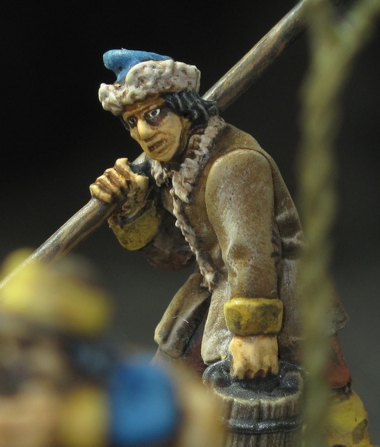
The command group from the Pike-man unit. These are really nicely sculpted and have great poses! Click and enlarge the picture we reveal the pike tip work done with kneadite “green stuff”

Swedish Warband 1630,

(36 x 28mm Figures, 24 infantry plus 12 cavalry)

Clean and prep. (mold lines and flash removed, figures washed, hands drilled)

Figure modifying and assembly. (Including handmade pikes & horse positioning)

Handmade flags and poles. (custom copper flags and steel poles.)

Prime with high quality automotive primer. (Krylon ulta flat black)

Painting to a Collector Standard. (Blending, highlighting, washes, aging, ect..)

Hand painted flags. (3 separate designs attributed to “The Blue Regiment”)

Figure sealing. (two coat of Testors gloss coat on figures, One coat gloss to seal base material, One coat dull coat to entire finished figure and base)

Mounting (3mm Litko plywood + .30mm magnets, custom 45 degree base clipping)

Base treatment. (filler putty, rocks, paint. Two color flock, Static grass, Tufting and flowers) The entire base is gloss coat sealed and the figure can be lightly washed, softly and quickly in cold water if needed to remove future dust.